Choosing between ASTM A653 and A1011 galvanized steel isn’t just about compliance—it’s about performance where it counts most: corrosion resistance, structural integrity, and long-term cost efficiency. For Industrial Steel applications like channel steel, steel angle, steel girder, and cold rolled steel, coating thickness directly impacts service life in harsh environments. Whether you’re a procurement professional evaluating SGCC alternatives, a technical assessor validating ASTM standard adherence, or a decision-maker balancing safety, budget, and durability—understanding when galvanizing thickness matters most is critical. As a trusted Structural Steel Manufacturer & Exporter from China, Hongteng Fengda delivers ASTM-compliant, quality-assured solutions for global construction and manufacturing projects.
Understanding the Core Difference: Coating Thickness Tolerance & Application Context
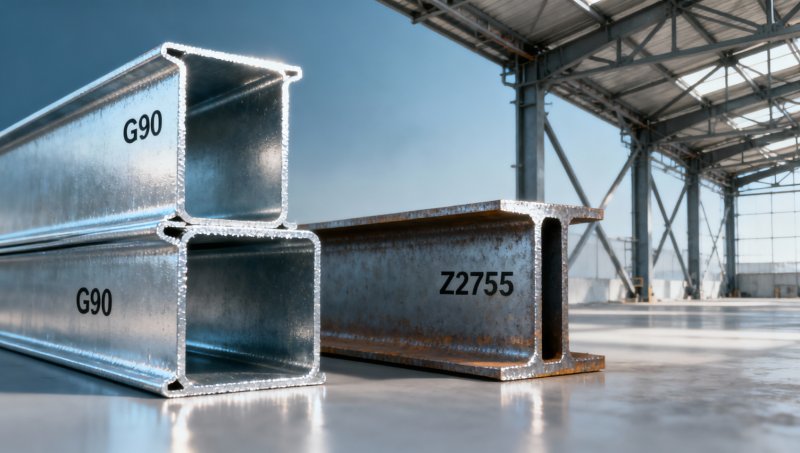
ASTM A653 and A1011 are both widely adopted specifications for hot-dip galvanized carbon steel sheet and strip—but they serve distinct roles in structural steel supply chains. A653 governs zinc-coated (galvanized) or zinc-iron alloy-coated (galvannealed) steel sheet, primarily used in cold-formed applications such as Metal C Beam, purlins, wall beams, and light framing components. Its coating mass is defined in ounces per square foot (oz/ft²), with common designations like G60 (0.60 oz/ft²) and G90 (0.90 oz/ft²)—equivalent to ~19–28 µm and ~28–43 µm average thickness, respectively.
In contrast, ASTM A1011 covers hot-rolled carbon, structural, high-strength low-alloy (HSLA), and improved formability steel sheets—including galvanized variants. Its coating designation uses “Z” followed by mass in g/m² (e.g., Z120 = 120 g/m² ≈ 17 µm). While A1011 permits lower minimum coating weights than A653 for equivalent grades, its typical base metal thickness ranges from 1.5 mm to 12 mm—making it more suitable for heavier structural members like columns, girders, and load-bearing brackets.
The divergence becomes operationally decisive in coastal, industrial, or high-humidity regions: a 15% reduction in coating thickness can accelerate corrosion onset by up to 40% under accelerated salt-spray testing (ASTM B117). That’s why specification selection must begin—not with material availability—but with exposure classification, design life expectancy (e.g., 25-year vs. 50-year service), and maintenance access constraints.
This table highlights why blanket substitution between A653 and A1011 is technically risky—even when chemistries align. For example, a G60-coated A653 sheet at 1.2 mm thickness may meet strength requirements for roof purlins but fail salt-fog endurance tests after 1,200 hours. Meanwhile, a Z275-coated A1011 beam at 6 mm thickness achieves >2,500-hour resistance while maintaining yield strength ≥345 MPa (Q345/S355 grade). The right choice hinges on matching coating mass *and* substrate geometry to environmental severity—not just nominal compliance.
Where Coating Thickness Matters Most: 4 Critical Application Scenarios
Coating thickness isn’t equally consequential across all use cases. It becomes non-negotiable where localized damage, moisture entrapment, or mechanical abrasion occurs during fabrication or service. Consider these four high-stakes scenarios:
- Marine & Coastal Infrastructure: Salt-laden air increases chloride ion deposition by 3–5× versus inland sites. Here, G90 (A653) or Z275 (A1011) is the minimum threshold—lower coatings risk red rust within 3–5 years.
- Industrial Roofing Systems: Purlins and wall beams supporting HVAC ducts or chemical vent lines face condensation cycles and airborne contaminants. Coating loss >15% due to cutting or drilling requires touch-up per SSPC-PA 2—adding labor cost of $8–$12/m².
- Mechanical Light Industry Framing: Columns and arms subject to vibration, thermal cycling, or incidental impact require ≥Z350 (50 µm) to sustain 20+ years without recoating—especially in humid Southeast Asia or Middle East installations.
- Custom Cold-Formed Components: When bending or punching Metal C Beam with thicknesses from 1 mm to 12 mm, edge thinning can reduce effective coating by 25–40%. Specifying Z275+ mitigates this risk across all bend radii ≥3× material thickness.
Hongteng Fengda applies strict process controls during continuous galvanizing—monitoring bath temperature (±1.5°C), immersion time (±2 sec), and withdrawal speed (±0.3 m/min) to ensure ±5% tolerance on declared coating mass. Every coil undergoes electromagnetic thickness verification pre-shipping, with full traceability to batch-level SGS-certified test reports.
Procurement Decision Framework: 6 Key Evaluation Criteria
When sourcing galvanized structural steel globally, procurement teams must balance technical rigor with commercial viability. Based on 12+ years of cross-border project support, here are six non-negotiable evaluation criteria:
- Coating Mass Verification Method: Demand mill test reports showing actual measured g/m²—not just nominal designation. Accept only results from destructive cross-section SEM or non-destructive XRF testing.
- Adhesion Performance: Confirm ASTM A90/A90M bend test compliance—no flaking or peeling after 180° wrap around a mandrel equal to substrate thickness.
- Surface Uniformity: Reject coils exhibiting bare spots, ash streaks, or excessive dross—these indicate bath contamination or improper flux control.
- Dimensional Tolerance Compliance: For C-beams, verify ±1% thickness tolerance and ≤0.5 mm flatness deviation per meter—critical for automated assembly lines.
- Lead Time Consistency: Verify production capacity: Hongteng Fengda maintains 8,500 MT/month galvanizing throughput, enabling stable 25–35 day lead times even for mixed-spec orders.
- Certification Alignment: Ensure CE, ISO 9001:2015, and BV-approved documentation—not just self-declared conformity.
These metrics directly influence total cost of ownership (TCO). A $120/ton premium for Z275 over Z120 translates to ~$0.85/m² added cost—but avoids $4.20/m² in scheduled recoating every 8 years, plus downtime penalties averaging $220/hour for industrial facilities.
Why Hongteng Fengda Delivers Confidence Across Global Standards
As a vertically integrated structural steel manufacturer, Hongteng Fengda operates dual-line galvanizing facilities certified to ASTM, EN 10346, JIS G3302, and GB/T 2518—with real-time bath chemistry monitoring and AI-driven thickness prediction models trained on 14,000+ production batches. Our Metal C Beam products—available in Q195 through S235JR, 1–12 mm thickness, and lengths up to 12 m—are routinely supplied to Tier-1 contractors in North America (complying with CSA G164), EU (CE-marked per EN 1090-2), and GCC countries (GCC Conformity Mark).
Unlike commodity suppliers, we co-engineer coating strategies: for example, recommending Z350 + powder coating hybrid systems for architectural façade supports in Dubai—achieving 60-year corrosion resistance while meeting UAE fire rating Class B-s1,d0. Every order includes digital twin documentation: 3D dimensional scan reports, coating thickness heatmaps, and batch-specific metallurgical analysis.
With ISO 9001, ISO 14001, and OHSAS 18001 certifications—and dedicated project managers fluent in English, Arabic, Spanish, and Russian—we eliminate sourcing friction across time zones, languages, and compliance frameworks.
Next Steps: Align Your Specification with Real-World Performance
Selecting between ASTM A653 and A1011 isn’t theoretical—it’s a field-proven decision that affects safety margins, lifecycle budgets, and brand reputation. If your project involves exposed structural elements in aggressive environments—or if you’re specifying custom cold-formed profiles like C-beams for modular construction—coating thickness isn’t an afterthought. It’s the first line of defense.
Hongteng Fengda invites technical review sessions with your engineering or procurement team. Share your application environment, loading requirements, and certification needs—we’ll deliver a compliant, cost-optimized specification package within 48 business hours, including coating validation protocols, dimensional inspection checklists, and logistics planning support.
Contact us today to request a free ASTM-compliance audit for your next structural steel order—or explore how our Metal C Beam solutions can accelerate your project timeline while de-risking long-term performance.
Please give us a message


Please enter what you want to find