Selecting the right pipe for power plant projects demands balancing cost, delivery reliability, and performance under high-pressure, high-temperature conditions. ASTM A106 pipe and API 5L pipe are both widely specified industrial pipes—but how do they compare in real-world procurement? As a China-based structural steel manufacturer and exporter, Hongteng Fengda supplies certified API 5L pipe, ASTM A106 pipe, corrosion-resistant plate, S235JR steel, SPCE/SPCD steel, and fluid pipe solutions—helping project managers, procurement teams, and safety-focused engineers make data-driven decisions without compromising on compliance or lead time.
Definition & Core Purpose
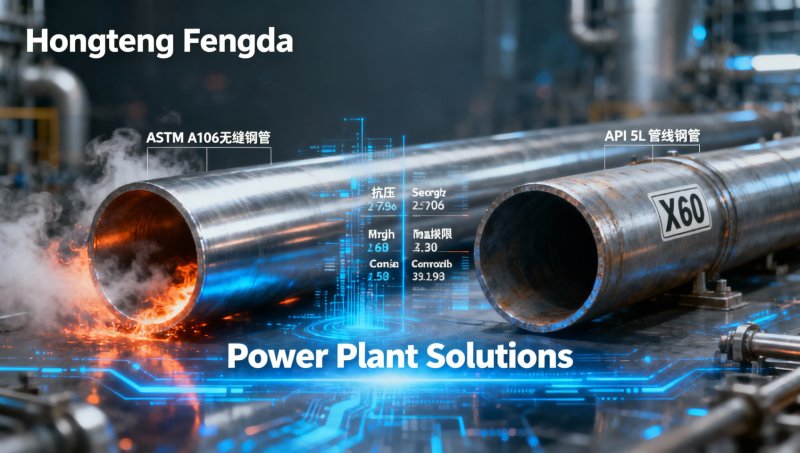
ASTM A106 pipe is a seamless carbon steel pipe standard developed by ASTM International, specifically engineered for high-temperature service in boiler, superheater, and pressure vessel applications. It is commonly used in steam lines, feedwater systems, and main piping networks where thermal stability and creep resistance are critical.
API 5L pipe, governed by the American Petroleum Institute, covers both seamless and welded line pipe intended primarily for pipeline transportation of oil, gas, and other fluids—including water injection, sour service (H₂S-rich), and offshore environments. While originally designed for energy transmission, its robust mechanical properties and broad grade range (e.g., Grade B, X42 to X80) have made it increasingly common in large-scale power infrastructure—especially for cooling water, ash handling, and fuel supply lines.
Technical Performance Comparison
Performance under extreme operating conditions separates these two industrial pipes—not just in specification, but in real-world behavior. Below is a comparative overview of key technical parameters aligned with typical power plant requirements:
Procurement Guide: Cost, Delivery & Supply Chain Realities
For procurement professionals and project managers, cost isn’t just about unit price—it’s total landed cost including certification, inspection, logistics, and schedule risk. Hongteng Fengda observes consistent patterns across 200+ global power plant projects: ASTM A106 pipe typically commands a 12–18% premium over equivalent-dimension API 5L pipe due to tighter chemistry controls, stricter NDE requirements (e.g., 100% ultrasonic testing), and lower production volumes.
Delivery timelines further differentiate them. Standard API 5L pipe (Grade B, X42–X52) benefits from high-volume rolling schedules and modular mill setups—enabling 6–10 week lead times from order confirmation. ASTM A106 Gr. B requires dedicated seamless billet processing and longer heat-treatment cycles, pushing standard delivery to 12–16 weeks unless expedited (with surcharge). For urgent retrofits or EPC fast-track schedules, this gap directly impacts commissioning dates.
Hongteng Fengda mitigates these constraints through dual-certified production lines—capable of manufacturing both ASTM A106 and API 5L pipe under one QA system—and maintaining strategic inventory of common sizes (NPS 6–24, SCH 40–120). Our ISO 9001–certified traceability ensures full mill test reports (MTRs), third-party inspection readiness (SGS/BV/TÜV), and seamless documentation handover for ASME Section III or EN 13480 compliance.
Application Scenarios in Power Generation
While both pipes meet “pressure-containing” criteria, their optimal deployment differs by system function. ASTM A106 dominates primary steam circuits—main steam headers, reheater outlets, and turbine inlet manifolds—where sustained creep resistance at >370°C is non-negotiable. Its fine-grained microstructure resists graphitization better than many API 5L grades under long-term exposure.
API 5L excels in secondary and auxiliary systems: circulating water intake, condensate polishing loops, flue gas desulfurization (FGD) slurry lines, and coal pulverizer feed piping. Its superior toughness at low temperatures, broader availability in large diameters (up to NPS 60), and compatibility with field welding (including automatic orbital) accelerate installation. Notably, API 5L X60/X65 with CRA cladding (e.g., duplex overlays) serves as a cost-effective alternative to solid stainless fluid pipe in aggressive chemical environments.
For structural integration—such as pipe rack supports, turbine foundations, or boiler framing—our H Section Beam series (Q345B, S355JR, ASTM A572) provides optimized load-bearing capacity, corrosion resistance via galvanizing or weathering steel options, and rapid erection thanks to standardized bolted connections.
Why Choose Hongteng Fengda?
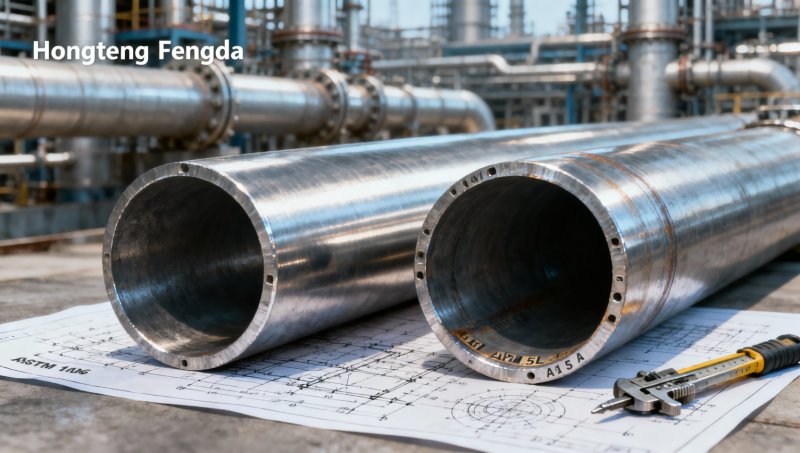
As a vertically integrated structural steel manufacturer and exporter from China, we combine deep metallurgical expertise with agile global logistics. Unlike commodity traders, we control raw material sourcing, rolling, heat treatment, NDE, and packaging—ensuring ASTM A106 pipe meets ASTM A106/A106M-23 Annex A1 (hydrostatic test + flattening), and API 5L pipe satisfies PSL2 requirements including HIC/SOHIC testing for sour service.
Our clients—from EPC contractors in Saudi Arabia to OEMs in Germany—rely on us for: consistent batch-to-batch repeatability; dual-standard certifications (ASTM + API + EN + GB); multi-port FOB flexibility (Qingdao, Tianjin, Shanghai); and bilingual engineering support for MTO validation, dimensional checks, and FAT coordination. With 18+ years serving North America, Europe, and ASEAN, we reduce procurement friction—not just cost.
Contact Hongteng Fengda today for a tailored pipe specification review, competitive quotation, or technical consultation on ASTM A106 pipe vs. API 5L pipe selection—backed by real-time mill capacity visibility and on-demand sample dispatch.
Please give us a message


Please enter what you want to find