For global buyers comparing ASTM A106 Gr.B equivalent options, understanding ASTM A106 Gr.B specification, ASTM A106 Gr B chemical composition, and ASTM A106 Gr B mechanical properties is essential for accurate material selection and cost control. This guide helps sourcing teams, engineers, and project managers evaluate ASTM A106 Gr B pipe alternatives across international standards while reducing procurement risks and ensuring reliable performance for industrial and structural applications.
In cross-border steel sourcing, equivalent grades are rarely a simple one-to-one substitution. Buyers must compare temperature service range, pressure class, manufacturing route, dimensional tolerances, and inspection scope before approving an alternative. A lower initial price can quickly turn into a higher total cost if the material requires re-qualification, additional testing, or delayed delivery.
For buyers working with suppliers across North America, Europe, the Middle East, and Southeast Asia, the challenge is not only finding a comparable steel grade, but also securing stable production, traceable quality records, and reliable export execution. That is why a structured review of ASTM A106 Grade B equivalent options matters for both engineering safety and procurement efficiency.
Understanding ASTM A106 Gr.B and Why Equivalents Are Used
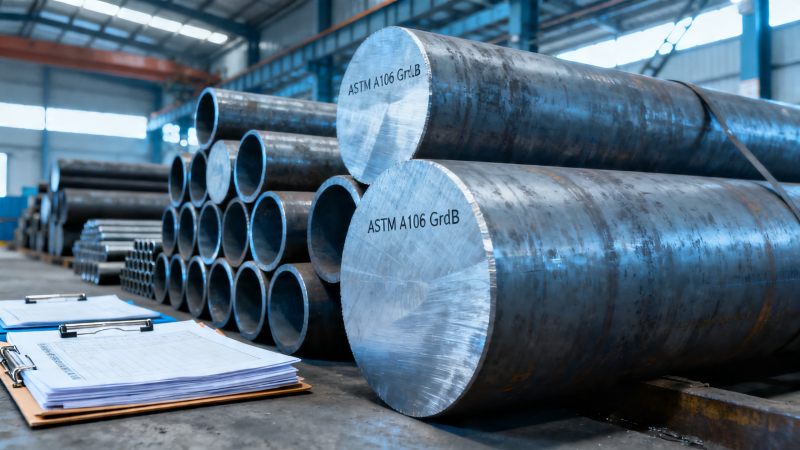
ASTM A106 Gr.B is a seamless carbon steel pipe grade widely specified for high-temperature service. It is commonly used in refineries, power plants, process piping, boilers, and general industrial systems where pressure and heat resistance are important. In many projects, ASTM A106 Grade B is selected because it offers a balanced combination of strength, weldability, and broad market availability.
From a technical perspective, ASTM A106 Gr B chemical composition is controlled to support pressure-bearing performance and fabrication reliability. Typical limits include carbon up to about 0.30%, manganese in the general range of 0.29% to 1.06%, phosphorus up to 0.035%, sulfur up to 0.035%, and silicon not less than 0.10%. These limits help maintain strength while keeping the material workable for cutting, welding, and bending.
ASTM A106 Gr B mechanical properties are also central to grade comparison. Common benchmark values include tensile strength of at least 415 MPa and yield strength of at least 240 MPa. These numbers are often the first screening criteria used by technical evaluators, but they should never be the only criteria. Elongation, flattening performance, hydrostatic testing, and non-destructive examination requirements can also affect final suitability.
Equivalent options are typically considered for 4 practical reasons: local standard preference, shorter lead time, lower landed cost, or mill production availability. For example, a project in Europe may prioritize EN grades, while a buyer in Asia may compare against JIS or GB materials to reduce sourcing time from 6–10 weeks to 3–6 weeks. In such cases, equivalency must be validated based on service conditions, not just on nominal chemistry.
Key factors behind substitution decisions
- Project specification may allow an approved alternative if the mechanical threshold is equal to or above the original requirement.
- Regional procurement teams may use local mills that produce EN, JIS, or GB grades more consistently than ASTM-designated materials.
- Some buyers need mixed sourcing strategies for urgent lots below 50 tons and framework orders above 200 tons.
- Export buyers often compare material cost, freight cycle, inspection cost, and customs documentation risk together.
For B2B steel sourcing, the safest approach is to treat ASTM A106 Grade B equivalents as engineering-reviewed alternatives rather than interchangeable commodities. This reduces approval delays and helps avoid downstream claims related to installation, pressure testing, or site acceptance.
Common International Equivalent Options and Comparison Logic
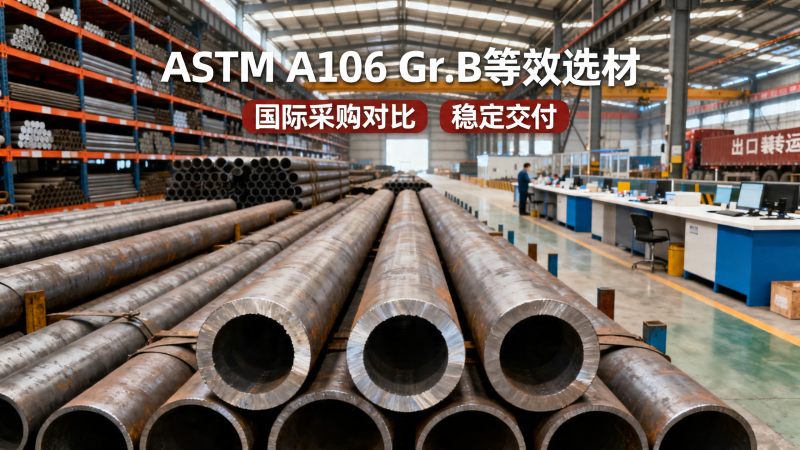
There is no universal equivalent that matches ASTM A106 Gr.B in every detail, but several international grades are frequently reviewed during sourcing. The most common comparisons include ASTM A53 Grade B, API 5L Grade B, EN P235GH/P265GH in selected applications, JIS STPG 370, and certain GB carbon steel pipe grades used for pressure service. Each option has a different balance of standard intent, test scope, and service suitability.
The first comparison point is manufacturing route. ASTM A106 Gr.B is primarily a seamless pipe specification for high-temperature service. ASTM A53 Grade B may be seamless or welded, which means it can fit some applications but not all. API 5L Grade B is often intended for line pipe service rather than process piping, so even if the strength looks similar, specification intent must be checked before substitution.
The second comparison point is testing and documentation. Some projects require hydrostatic testing on every pipe, full heat number traceability, PMI support, or third-party inspection. If the substitute grade needs extra testing to satisfy project approval, the apparent savings of 3%–8% on ex-works price may disappear after additional inspection and qualification steps.
The table below outlines common reference options used during international sourcing reviews. It is not a blanket substitution chart, but it helps buyers narrow the technical review process faster.
The key takeaway is that equivalent options should be reviewed through 3 layers: performance equivalence, standard intent, and project acceptance. A grade can look close in chemical and mechanical data yet still fail project approval because of different testing clauses or code references.
How engineers usually validate an equivalent
- Confirm operating temperature, pressure range, and corrosion allowance.
- Compare chemistry and minimum tensile/yield values.
- Review seamless versus welded manufacturing acceptability.
- Check NDT, hydrotest, certification, and traceability requirements.
- Obtain engineering and client approval before procurement release.
Technical Evaluation: Chemistry, Mechanical Properties, and Application Fit
When comparing ASTM A106 Gr.B equivalent options, the most common mistake is focusing only on yield and tensile strength. In practice, application fit depends on at least 5 technical dimensions: chemistry, mechanical properties, manufacturing method, dimensional tolerance, and test requirements. A proper review should also consider welding procedure compatibility and post-fabrication performance.
ASTM A106 Gr B chemical composition matters because small differences in carbon, manganese, and residual elements influence weldability and service behavior. For example, higher carbon can improve strength but may reduce welding ease in field fabrication. If the project includes 20–50 field joints per line section, welding productivity and repair rate become important cost factors, not just engineering details.
ASTM A106 Gr B mechanical properties provide a baseline, but engineers should also examine elongation, hardness tendencies, and suitability for forming or flanging if needed. In maintenance-heavy plants, a material that meets minimum strength but responds poorly to onsite modification can increase shutdown time. For project managers, even a 2-day delay in spool correction can affect commissioning schedules.
The table below shows a practical technical screening method used by many sourcing and QA teams before moving to supplier quotation comparison.
For structural and industrial buyers working with multiple steel categories, it is also useful to align pipe sourcing decisions with broader steel procurement planning. In projects involving both pipe systems and fabricated steel parts, using suppliers with cross-standard manufacturing familiarity can reduce coordination gaps between ASTM, EN, JIS, and GB documentation.
As an example of adjacent procurement planning, some buyers also source sheet and plate materials for equipment housings, switchboards, vehicle-related components, or formed steel parts in the same supply cycle. For such needs, Carbon Steel Plate can support applications such as refrigerators, rails, switchboards, automobile chassis parts, roofs, and interior panels, with thickness options from 0.1 mm to 400 mm, widths from 100 mm to 3000 mm, and lengths from 1 m to 12 m.
In that product category, grades such as SPCC, SPCD, SPCE, SPCF, and SPCG are often selected according to forming depth and surface requirements. For instance, SPCC grade chemistry typically limits C to not more than 0.15% and Mn to not more than 0.60%, while deeper drawing grades tighten these ranges further. This kind of integrated sourcing model can help procurement teams consolidate supplier qualification and export coordination under one steel supply strategy.
Practical technical checks before final approval
- Request MTC review before shipment for every heat, not only sample batches.
- Confirm whether the project needs normalized condition or standard hot-finished supply.
- Check wall thickness tolerance and end preparation if pipes will be site welded immediately after delivery.
- If the material is replacing an owner-approved brand, verify re-approval lead time, which may range from 3 to 14 working days.
Procurement Risks, Cost Control, and Supplier Qualification
From a commercial point of view, global sourcing of ASTM A106 Gr.B equivalents involves more than comparing unit price per ton. Buyers should evaluate at least 4 cost layers: base material price, testing and inspection cost, logistics cost, and risk cost. A quotation that is 40 to 80 USD per ton lower may still be less competitive if it causes extra approval steps or shipment delay.
Procurement teams also need to assess supplier execution capability. For export projects, stable output, packing quality, document accuracy, and delivery discipline can influence project cash flow. A missed vessel booking or an incomplete certificate package can hold customs clearance for 5–10 days, affecting installation schedules and contractor claims.
For buyers seeking dependable steel supply from China, it is useful to work with manufacturers familiar with international standards and customized requirements. Hongteng Fengda, as a structural steel manufacturer and exporter from China, supports global construction, industrial, and manufacturing projects with standard and OEM-oriented steel products. With modern production facilities and strict quality control, the company works with ASTM, EN, JIS, and GB requirements to help reduce sourcing uncertainty.
The decision matrix below can help procurement, QA, and management teams align their evaluation before placing an order.
A reliable supplier qualification process usually includes 6 checkpoints: standard familiarity, production capability, dimensional control, inspection records, export experience, and after-sales responsiveness. This approach is especially important for distributors, EPC contractors, and project owners managing multiple packages at the same time.
Supplier review checklist
- Ask whether the mill can support ASTM, EN, JIS, and GB documentation in parallel when needed.
- Confirm whether production lots are stable for repeated orders over 3 to 6 months.
- Review packing, marking, and traceability method for mixed export cargo.
- Check if custom fabrication or OEM support is available for related structural steel packages.
Implementation Advice, Common Mistakes, and FAQ for Global Buyers
Once a potential ASTM A106 Gr.B equivalent is identified, implementation should follow a disciplined process. Technical and commercial teams should avoid parallel assumptions. The safest method is to align specification review, quotation review, and approval workflow in a single document set so that engineering, procurement, QA, and finance work from the same criteria.
A common mistake is approving an equivalent based only on tensile and yield numbers shown in a sales datasheet. Another frequent issue is ignoring end-use differences, such as high-temperature process piping versus general fluid transport. Even if two grades seem close, their intended service environment and inspection scope may differ enough to affect acceptance.
For project managers, a practical rollout model includes 3 stages: pre-qualification, technical confirmation, and shipment control. This creates a clear path from RFQ to delivery and reduces uncertainty for stakeholders such as operators, safety managers, and financial approvers. On urgent orders, this workflow can save several rounds of clarification and reduce approval friction.
Below are frequently asked questions that reflect real sourcing concerns from technical teams and buyers handling industrial and structural steel procurement across regions.
How should buyers choose between ASTM A53 Gr.B and ASTM A106 Gr.B?
Start with application. If the project specifically requires seamless carbon steel pipe for high-temperature service, ASTM A106 Gr.B is usually the more direct fit. ASTM A53 Gr.B may work in some general service conditions, but buyers must verify whether welded pipe is acceptable, whether the temperature range is suitable, and whether owner specifications permit the substitution.
What documents should be reviewed before approving an equivalent?
At minimum, review the material test certificate, standard specification sheet, chemical composition range, mechanical property values, manufacturing route, inspection plan, and traceability method. For critical projects, third-party inspection scope and marking details should also be checked before production release.
What lead time is typical for global sourcing?
For common sizes and standard export packing, production may take about 3–6 weeks depending on mill schedule and order quantity. If third-party inspection, special end preparation, or mixed-standard documentation is required, the cycle can extend to 6–10 weeks. Freight transit then depends on destination and vessel space.
What is the safest way to reduce procurement risk?
Use a dual review approach: engineering confirms technical equivalence, while procurement confirms delivery, certification, and commercial terms. This reduces the chance of buying a low-cost grade that later fails project approval or causes rework at site.
Selecting ASTM A106 Gr.B equivalent options for global sourcing requires more than a grade cross-reference. Buyers need to evaluate chemistry, strength, manufacturing route, inspection scope, and project approval requirements together. When these factors are reviewed systematically, sourcing teams can control cost without increasing compliance or performance risk.
For companies looking for a dependable steel supply partner from China, Hongteng Fengda supports international buyers with stable production capacity, consistent quality control, and export-oriented service across multiple steel standards. If you need support comparing equivalent grades, reviewing specifications, or planning a broader steel sourcing package, contact us now to get product details, technical guidance, and a customized solution.
Please give us a message


Please enter what you want to find