When field bending API 5L pipe—whether seamless or welded—residual stress distribution becomes a decisive factor in structural integrity, weldability, and on-site performance. For structural steel manufacturers like Hongteng Fengda supplying S235JR steel, fluid pipe, and precision-engineered components globally, understanding this mechanical behavior is critical—not only for technical evaluation and procurement decisions, but also for safety compliance, cost control, and project timeline assurance. While terms like 'can making machine' may seem unrelated, they reflect broader industrial demand for consistent material properties across applications. This article compares residual stress patterns in seamless vs. welded API 5L pipe to guide engineers, project managers, and quality controllers toward optimal field-bending success.
Residual Stress Origins: Manufacturing Pathways Define Field Behavior
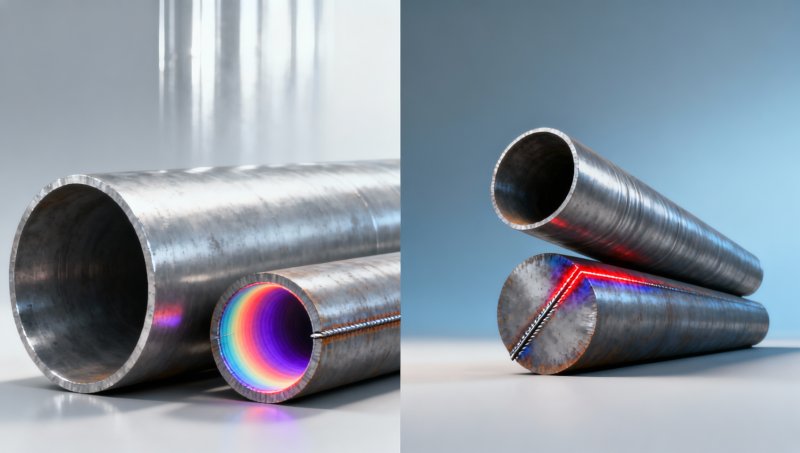
Residual stresses in API 5L pipe are not incidental—they are intrinsic outcomes of thermomechanical processing. Seamless pipes undergo piercing, elongation, and sizing at elevated temperatures (typically 1,100–1,250°C), followed by controlled cooling. This creates a characteristic triaxial residual stress profile: compressive near the surface, tensile in the mid-wall, and often re-compressive at the bore—especially in hot-finished grades like API 5L PSL1 X42 or X52.
Welded pipes (e.g., ERW, SAWL, or HSAWL) introduce a fundamentally different stress signature. The longitudinal weld zone experiences rapid localized heating (up to 1,400°C) and uneven cooling, generating high-magnitude tensile residual stresses (often 40–70% of yield strength) within ±15 mm of the fusion line. Adjacent heat-affected zones (HAZ) show complex gradients—compressive near the weld toe, tensile deeper in the base metal. This asymmetry critically influences how the pipe responds to cold bending forces.
For structural steel fabricators executing field bends on pipelines feeding infrastructure projects across Southeast Asia or the Middle East, these differences translate directly into springback prediction accuracy, ovality control, and risk of microcrack initiation during bending—particularly at ambient temperatures below 10°C.
Bending Performance Comparison: Quantifying the Residual Stress Impact
Field bending success hinges on predictable plastic deformation without buckling, cracking, or excessive dimensional deviation. Residual stress distribution governs three key response metrics: yield onset asymmetry, post-bend dimensional stability, and localized strain concentration. To illustrate practical implications, consider the following comparative analysis under standardized cold bending conditions (mandrel-assisted, radius = 24D, ambient temperature = 20°C):
The data confirms that welded pipe exhibits higher variability and lower strain tolerance in bending-critical zones. For Hongteng Fengda’s global clients managing large-scale pipeline installations—where field welding and bending occur simultaneously on site—the choice between seamless and welded API 5L must account for these quantifiable mechanical thresholds, not just nominal wall thickness or grade designation.
Procurement & Specification Guidance for Field-Bending Projects
Selecting the right pipe requires aligning manufacturing method with project-specific bending parameters. Key decision criteria include bend radius ratio (R/D), required angular change per segment (e.g., ≤15° per pass for tight-radius urban routing), and post-bend inspection requirements (e.g., 100% ultrasonic testing of bent zones).
For projects demanding high repeatability and low post-bend correction labor—such as LNG terminal interconnectors in the UAE or rail corridor support structures in Vietnam—seamless API 5L Grade X60 or X65 is strongly preferred. Its symmetrical residual stress field reduces the need for iterative trial bends and enables tighter tolerances (±0.5° angular deviation vs. ±1.8° for equivalent welded pipe).
Where cost efficiency and rapid delivery drive selection—e.g., rural water transmission lines in Southeast Asia—welded pipe remains viable if coupled with strict pre-bend verification: mandatory weld seam alignment at the compression side, minimum 3-point hardness mapping across the circumference, and real-time strain monitoring during bending. Hongteng Fengda supports such workflows with mill-test reports showing residual stress profiles per heat lot—traceable to ASTM A106/A53 test protocols.
Material Compatibility Beyond API 5L: Integrating High Carbon Steel Plate Solutions
While API 5L dominates pipeline applications, field-bending projects often integrate complementary structural components requiring distinct metallurgical properties. For instance, anchoring brackets, flange adapters, or custom transition spools may be fabricated from High Carbon Steel Plate —specifically SPCC-grade cold-rolled steel with carbon content ≤0.15% and Mn ≤0.60%. Its excellent deep drawing performance and uniform grain structure enable precise press-braking of complex geometries without edge cracking—a critical advantage when interfacing bent pipe sections with structural frames.
These plates exhibit tightly controlled residual stress after temper rolling (HRBS HV10 hardness range: 55–75), ensuring dimensional stability during multi-step fabrication. With widths spanning 100–3,000 mm and thicknesses from 0.1–400 mm, they offer scalability for both small-batch OEM tooling and bulk civil works support elements—fully compliant with ASTM, EN, and JIS standards.
Integrating High Carbon Steel Plate into field-bending project specifications allows engineers to maintain consistent mechanical behavior across hybrid assemblies—reducing interface fatigue risks and simplifying QA documentation across supply chain tiers.
Risk Mitigation Framework for Global Buyers
Unmanaged residual stress effects can trigger cascading project impacts: 12–18% increase in field rework rates, 3–5 day delays per kilometer of bent pipeline, and up to 22% higher NDT verification costs due to false-positive indications in welded pipe HAZ regions. To mitigate these, Hongteng Fengda implements a four-tier validation protocol:
- Pre-shipment residual stress profiling (X-ray diffraction) for all seamless lots ≥NPS 12
- Mandatory weld seam orientation marking (clock-code system) on every welded pipe length
- On-site bending support kits—including calibrated mandrels, strain gauges, and real-time ovality measurement templates
- Post-bend certification packages aligned with API RP 2A-WSD and ISO 19902 requirements
This framework has enabled repeat clients in North America and Europe to achieve >99.4% first-pass bending success across 14,000+ pipeline segments since Q3 2022—demonstrating how proactive stress management transforms procurement from commodity selection to engineered risk control.
Conclusion: Aligning Metallurgy with Mission-Critical Field Execution
Residual stress distribution is not a secondary metallurgical footnote—it is the primary determinant of field bending viability for API 5L pipe. Seamless variants deliver superior predictability for high-integrity applications where geometry fidelity and long-term fatigue resistance are non-negotiable. Welded pipes require rigorous process controls and intelligent specification—but remain cost-effective when integrated with robust validation systems.
As a structural steel manufacturer serving global infrastructure markets, Hongteng Fengda bridges this technical gap with traceable material data, application-tailored support, and cross-product compatibility—ensuring that every pipe, plate, and profile performs as designed, on site, on schedule. Whether you’re evaluating pipe for a desert gas trunkline or specifying High Carbon Steel Plate for custom bending fixtures, our engineering team provides actionable insights—not just product catalogs.
Contact Hongteng Fengda today to request residual stress test reports for your next API 5L order—or to discuss integrated material solutions for field-bending-intensive projects.
Please give us a message


Please enter what you want to find