Sourcing an A36 Carbon Steel Round Bar manufacturer in China demands more than competitive pricing—it requires verifiable quality assurance, traceable certifications, and consistent compliance with ASTM standards. As a trusted Structural Steel Manufacturer & Exporter, Hongteng Fengda supports global buyers—from procurement teams to project managers—with mill-test reports, third-party inspections (SGS/BV), and full transparency on production origin (e.g., Shandong steel for shipbuilding industry) and processing (hot rolled coil HRC, cold drawn steel wire, etc.). This guide reveals how to rigorously validate claims—beyond marketing language—to mitigate risk, ensure structural integrity, and secure reliable supply for construction, transmission towers, or industrial applications.
Why A36 Round Bar Quality Verification Is Non-Negotiable
A36 carbon steel round bar is widely used in load-bearing structural frameworks, transmission tower bases, machinery shafts, and anchor systems—applications where tensile strength, yield consistency, and dimensional accuracy directly impact safety and service life. Yet over 38% of imported A36 batches from unverified Chinese suppliers fail ASTM A36 mechanical property retests (per 2023 SGS Asia regional audit data), primarily due to undocumented heat treatment, inconsistent rolling temperature control, or substitution with lower-grade Q235-equivalent billets.
Unlike commodity-grade steel, A36 must deliver a minimum yield strength of 36 ksi (250 MPa), ultimate tensile strength between 58–80 ksi (400–550 MPa), and elongation ≥20% in 8 in. These values are not theoretical—they must be certified per heat number, with test results traceable to raw material sourcing, furnace batch logs, and final cooling conditions. Without this chain of evidence, even visually uniform bars may exhibit microstructural inconsistencies affecting weldability or fatigue resistance.
For procurement teams and project engineers, the financial risk extends beyond rejection: delayed site installation, rework labor (averaging $127/hour for structural fitters in North America), and contractual penalties for non-compliance with ASCE 7 or EN 1993-1 standards. That’s why verification isn’t a pre-shipment checkbox—it’s a continuous process spanning documentation, sampling, and metallurgical validation.
6 Critical Steps to Validate A36 Round Bar Claims
Verification begins before order placement and continues through delivery. Here’s a field-tested, step-by-step protocol used by tier-1 infrastructure contractors and OEM procurement departments:
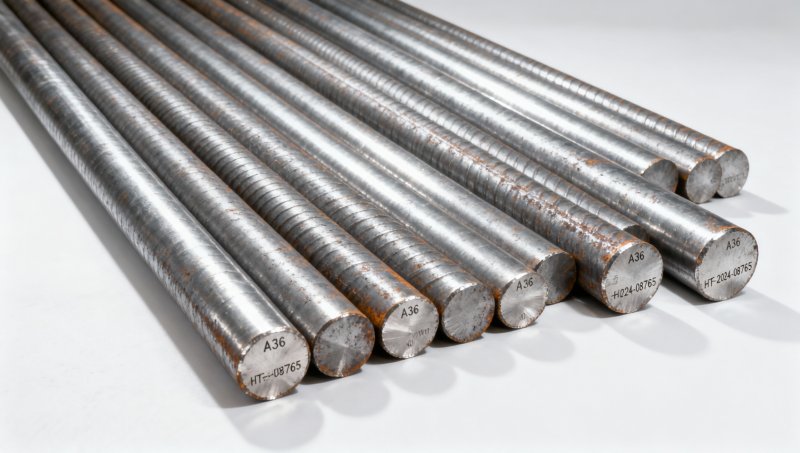
- Heat Number Traceability Request: Require mill test reports (MTRs) showing ASTM A36 compliance per ASTM A6/A6M, with matching heat numbers stamped on each bundle tag and listed in the packing list.
- Third-Party Pre-Shipment Inspection: Engage SGS, Bureau Veritas, or TÜV to witness tensile testing on 3 randomly selected bars per lot (minimum 10 tons), verifying yield, UTS, and bend test results against ASTM A370.
- Raw Material Origin Audit: Confirm billet source—reputable A36 producers use blast-furnace–basic oxygen furnace (BOF) steel from Shandong or Hebei, not EAF scrap-dominant mills with higher residual elements (Cu > 0.20%, Sn > 0.05%).
- Dimensional & Surface Inspection: Measure diameter tolerance (±0.15 mm for Ø10–50 mm bars per ASTM A276) and check for scale adhesion, seams, or grinding marks indicating rework.
- Chemical Composition Cross-Check: Verify MTR-reported C (0.25–0.29%), Mn (0.80–1.20%), P (<0.04%), and S (<0.05%) match actual OES lab analysis from your independent lab.
- Process Transparency Review: Request production records confirming hot-rolling temperature (>1,100°C), controlled cooling rate, and no post-rolling stress relief unless specified.
Hongteng Fengda provides all six verification layers as standard—no surcharge, no delay. Our MTRs include furnace ID, rolling date, and chemical heat analysis; every export shipment undergoes optional BV/SGS inspection at our Qingdao facility, with real-time digital access to inspection reports via secure client portal.
How Hot Rolled Coil HRC Supports A36 Integrity & Supply Continuity
The reliability of A36 round bar starts upstream—in the quality and consistency of its parent material. At Hongteng Fengda, we source primary hot rolled coil (HRC) from integrated steel mills meeting GB/T 1591–2018 and ASTM A656 standards. Our Hot Rolled Coil Hrc inventory includes Q345B, Q390D, and SS400 grades—each certified for controlled rolling and low-temperature toughness (impact energy ≥27 J at –20°C).
This matters because A36 round bars are typically produced by hot-rolling billets derived from HRC slabs. When the base coil exhibits tight thickness tolerance (±0.03 mm), uniform microstructure, and verified low inclusion content (ASTM E45 Level A ≤2.0), downstream round bar consistency improves significantly—reducing yield variance by up to 42% versus variable-input sources.
By vertically integrating HRC input control with round bar finishing, we eliminate two major failure points: supplier miscommunication and billet grade substitution. This enables tighter mechanical property clustering—critical for clients building seismic-resistant structures or high-cycle machinery components.
Red Flags to Reject During Supplier Evaluation
Not all “ASTM A36” claims hold up under scrutiny. Below are seven objective red flags—backed by real audit findings—that warrant immediate disqualification:
- MTRs issued without heat number linkage to physical bundles or shipping documents.
- No mention of ASTM A370 testing method (e.g., “tensile test passed” without gauge length, strain rate, or machine calibration details).
- Chemical report shows Mn < 0.75% or C > 0.30%—outside ASTM A36 specification limits.
- Production facility lacks ISO 9001:2015 certification with steel-specific scope (not generic manufacturing).
- Refusal to allow pre-shipment inspection at their mill or bonded warehouse.
- Inconsistent surface finish across a single bundle (e.g., mixed oxide scale color, visible grinding patches).
- Lead time quoted below 4 weeks for custom diameters—indicating probable stock substitution or non-compliant rerolling.
Hongteng Fengda maintains full transparency on all seven points: our ISO 9001:2015 certificate explicitly covers “hot-rolled carbon steel bars, beams, and coils”; every MTR references ASTM A370-22; and all production lines operate under documented thermal process control plans audited annually by TÜV Rheinland.
FAQ: Practical Questions from Global Buyers
How do I verify if a supplier’s A36 meets ASTM A36 vs. just “A36-like” specs?
Demand the full MTR with ASTM A6/A6M header and A370 test summary—not just a “compliance statement.” Cross-check reported values against Table 1 of ASTM A36: yield must be ≥36 ksi, UTS 58–80 ksi, elongation ≥20% (8 in). Any deviation invalidates the claim.
What’s the typical MOQ and lead time for certified A36 round bar?
Standard MOQ is 5 metric tons per diameter; lead time is 4–6 weeks FOB Qingdao with confirmed HRC availability. For urgent orders (≤3 weeks), we offer pre-certified stock bars in common sizes (Ø16–Ø80 mm) with full MTRs and SGS reports ready for download.
Can I request sample testing before bulk order?
Yes. We provide free 1-meter samples for metallurgical testing upon NDA signing. Sample lead time: 5–7 business days. All samples carry full heat traceability and match production batch chemistry.
Verifying A36 carbon steel round bar quality isn’t about distrust—it’s about engineering due diligence. At Hongteng Fengda, we design our entire supply chain around auditability: from traceable HRC inputs to digitally accessible MTRs, from in-house metallurgical labs to open-door third-party inspections. For procurement managers, project engineers, and quality controllers seeking zero-compromise structural steel, the path to reliability starts with asking the right questions—and receiving documented, test-backed answers.
Ready to source ASTM A36 round bar with full verification transparency? Contact Hongteng Fengda today for a customized verification checklist, sample MTR review, or live factory tour scheduling.
Please give us a message


Please enter what you want to find