When buyers compare 316L stainless steel pipe prices, the gap often comes from processing, not just raw material costs.
Surface finish, tolerance control, cutting, welding, and custom fabrication often reshape the final quotation.
Understanding these details helps control budgets, reduce sourcing risks, and improve project reliability in steel purchasing.
Why does 316L stainless steel pipe pricing vary so much?
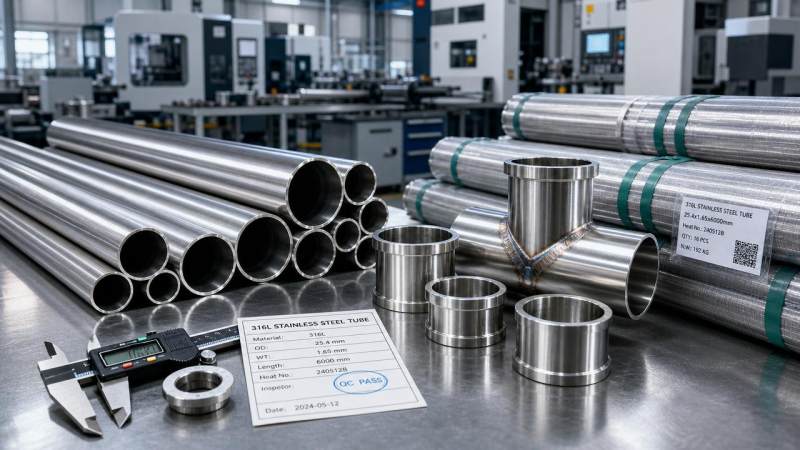
At first glance, many products appear similar.
Yet 316L stainless steel pipe price differences often reflect hidden processing steps rather than simple material weight.
The base alloy cost is important, especially because 316L contains molybdenum and low carbon content.
However, processing can raise the total cost far beyond the raw stainless input.
Common cost drivers include:
- cold drawing or precision sizing
- surface polishing or pickling
- strict wall thickness tolerance
- straightness correction
- non standard cutting lengths
- beveling, threading, or grooving
- special testing and documentation
This is why two quotes for 316L stainless steel pipe may differ sharply even under the same size specification.
The difference is often a manufacturing detail, not a pricing mistake.
Which processing steps increase the final 316L stainless steel pipe cost most?
Several processing operations have a direct effect on the final quote.
Among them, surface treatment is one of the easiest to overlook.
1. Surface finish requirements
Mill finish is usually the most economical option.
Brushed, polished, mirror, or passivated finishes need more labor, equipment time, and inspection.
If appearance matters, processing costs rise quickly.
2. Dimensional tolerance control
Tighter tolerance means more process control.
It may require additional drawing, calibration, sorting, and rejection of out of range pieces.
This often explains a higher 316L stainless steel pipe unit price.
3. Cutting and end preparation
Standard mill lengths are cheaper than customized lengths.
Short cut pieces create more waste and handling time.
Beveling, deburring, threading, or chamfering adds more cost.
4. Welding and fabrication
Some orders include bends, spools, supports, or welded assemblies.
That transforms a pipe order into a fabrication project.
Welding quality control, heat input management, and post weld cleaning all affect cost.
5. Testing and certification
Hydrostatic testing, PMI, roughness checks, or third party inspection add value and cost.
For export steel supply, paperwork can influence the final number more than expected.
How can buyers tell whether a low 316L stainless steel pipe quote hides processing risks?
A low quote is not automatically bad.
But it deserves careful comparison beyond price per ton or price per meter.
Review the quotation against actual project needs.
A useful comparison method is to normalize every quote into the same processing scope.
Without this step, 316L stainless steel pipe price analysis becomes misleading.
What applications make processing quality more important than the lowest price?
Processing quality becomes critical when the pipe serves demanding environments or visible installations.
Typical applications include chemical systems, marine projects, food equipment, water treatment, and architectural fabrication.
In such cases, poor finishing or loose tolerance may create corrosion points, fit up issues, or rework costs.
The same logic also appears across broader steel sourcing.
For example, custom lengths, surface treatments, and standard compliance affect more than stainless items alone.
Projects that also use A36 Carbon Steel Round Bar often face similar decisions.
That product is widely used in construction, manufacturing, engineering, decoration, railings, furniture, and shipment structures.
Available lengths include 2m, 5m, 6m, and 12m, with diameters from 5mm to 2500mm.
Its tensile strength can reach ≥520MPa, with options like passivation, oiling, phosphating, painting, or anti rust oil.
Standards such as ASTM, DIN, JIS, GB, AISI, SUS, and EN also shape the final supply cost.
This comparison shows a simple truth.
In steel procurement, processing scope often decides value more than nominal material grade alone.
How should 316L stainless steel pipe quotes be compared fairly?
A fair comparison needs a detailed checklist.
It should align price, specification, processing, inspection, and delivery conditions.
- Confirm grade, standard, and pipe type.
- Define OD, wall thickness, length, and tolerance clearly.
- List surface finish requirements in writing.
- State whether cutting, beveling, or fabrication is included.
- Check if testing documents are part of the quoted price.
- Review packing, lead time, and export protection.
This method helps reveal if one supplier priced only raw pipe while another included real project ready processing.
A higher quote may actually reduce total installed cost.
What common misunderstandings affect 316L stainless steel pipe purchasing?
Several misunderstandings appear repeatedly in stainless steel pipe sourcing.
Does the lowest price always mean the best value?
No.
The lowest 316L stainless steel pipe quote may exclude finishing, inspection, or exact cutting.
Is all 316L stainless steel pipe processed the same way?
Not at all.
Production routes, welding methods, pickling quality, and tolerance control vary by mill and equipment level.
Can site processing replace factory processing easily?
Usually not efficiently.
Factory processing is often more consistent and reduces field labor, scrap, and installation delays.
Are certification requirements just paperwork?
They are more than paperwork.
For regulated industries, missing documents can stop acceptance even when the pipe itself looks acceptable.
What is the practical way to reduce 316L stainless steel pipe sourcing risk?
Start with a complete technical inquiry, not just a material request.
Include application, finish, tolerance, end condition, tests, and delivery expectations.
Then compare suppliers on consistency, not only price.
A capable structural steel manufacturer and exporter should offer stable production, international standard compliance, and dependable lead times.
Reliable partners also help reduce sourcing risk through clear communication and customized steel solutions.
That matters when orders involve both standard supply and processed steel components.
In the end, 316L stainless steel pipe prices often differ because processing scope differs.
Surface finish, tolerance, cutting, fabrication, and testing can each change the real project cost.
A better decision comes from comparing complete specifications, not headline numbers alone.
For steel projects that require steady quality, custom support, and export ready supply, a detailed quotation review is the best next step.
Please give us a message


Please enter what you want to find