In chloride service, 316 usually reduces corrosion risk more effectively than 304 because molybdenum improves resistance to pitting and crevice attack. That difference matters when stainless steel is exposed to seawater spray, deicing salts, brine, wet insulation, washdown chemicals, or stagnant deposits that hold chlorides against the surface. If the environment stays dry and contamination is limited, 304 can still perform well. Once chlorides remain on the metal for long periods, the margin between the two grades becomes much more practical than theoretical.
The common mistake is to compare 304 and 316 only by their basic stainless classification. In real service, failure often starts locally. A surface can look acceptable overall while tiny pits develop under salt residue, around weld tint, inside bolted joints, beneath gaskets, or at the toe of a weld. Those local attacks can spread faster than general staining suggests, especially where cleaning is irregular or oxygen access is restricted. For that reason, the question is rarely whether 304 is “stainless enough” in air. The better question is whether the actual chloride exposure creates conditions for localized breakdown.
Where 316 gains its advantage
Both 304 and 316 rely on a passive chromium-rich oxide film for corrosion resistance. Chlorides can damage that film, and once the passive layer is destabilized, pitting may start. The molybdenum in 316 improves the steel’s ability to resist that localized attack and to repassivate more effectively in many chloride-bearing conditions. This does not make 316 immune. It means the threshold for damage is generally higher, which is often enough to change inspection frequency, repair burden, and service life expectations.
That advantage becomes more visible in locations such as:
- coastal structures with intermittent salt deposition rather than full immersion,
- equipment frames near chlorinated process lines,
- architectural or structural components exposed to deicing salt splash,
- handrails, supports, enclosures, and pipework in water treatment areas,
- fabrications with lap joints, crevices, clamps, or insulation details that trap moisture.
In these cases, 304 may remain bright for a period and still be at risk beneath deposits or in sheltered geometry. 316 is often selected not because the surface must look better on day one, but because it offers more tolerance when operating conditions become less controlled than the specification assumed.
304 is not a bad grade; it is a narrower fit
304 remains a sound material in many indoor, clean, and low-chloride applications. It is widely used because it balances corrosion resistance, formability, weldability, and availability. Problems begin when 304 is extended into environments where chlorides are present but underestimated. Typical examples include “occasionally washed” areas that actually stay damp, chemical storage zones with airborne contamination, or outdoor installations where salt deposition is seasonal rather than constant. These are the conditions that often produce disputes later, because the service description sounded moderate while the surface chemistry was not.
That is also why stainless grade selection should not be based on the word “outdoor” or “marine” alone. Distance from the coastline, wind direction, trapped contamination, cleaning intervals, and horizontal versus vertical orientation can all shift exposure severity. A vertical member that is rain-washed may perform differently from a horizontal cover plate only a short distance away. 304 may be acceptable on one component and marginal on another within the same site.
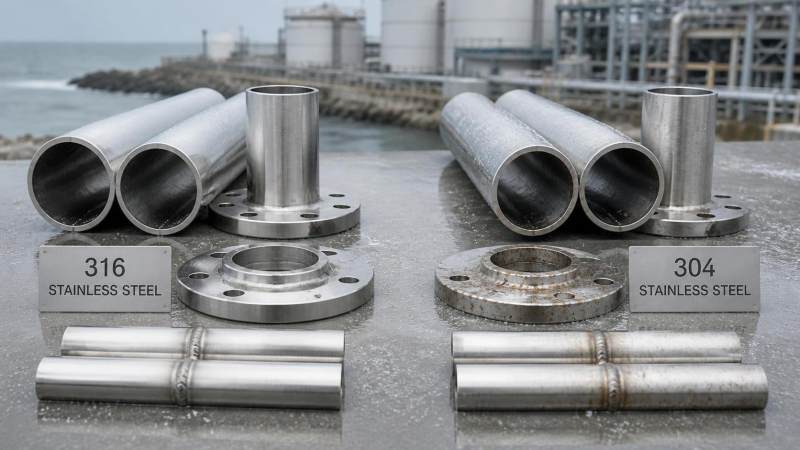
How chloride corrosion actually appears in the field
Pitting usually starts as small points that can be easy to miss during routine visual review. Tea staining may appear first on some surfaces, but it should not be treated as a simple cosmetic issue without further examination. In chloride service, discoloration can indicate that deposits are remaining on the metal long enough to disturb the passive film. Crevice corrosion is even easier to overlook because it develops under washers, seals, supports, sediment, and overlapping connections. Once the attack is hidden, section loss can progress without an obvious warning from a distance.
Welded areas deserve special attention. Poor shielding, excessive heat tint, embedded iron contamination from tooling, or rough post-weld finishing can reduce local corrosion resistance regardless of whether the base metal is 304 or 316. A poorly fabricated 316 assembly can underperform a well-finished 304 component in a milder chloride setting. Grade choice and fabrication quality have to be assessed together.
Points that affect the decision more than many specifications admit
Surface finish matters. Smoother finishes generally retain fewer deposits and are easier to clean. Rougher surfaces, turning marks, and heat-tinted weld zones can hold contaminants longer. Geometry matters just as much. Drainage paths, venting, slope, and access for washing often determine whether chlorides remain active on the surface. A flat stainless cover that traps saline residue may fail sooner than a vertical panel of the same grade.
Temperature also changes the picture. Warmer chloride-bearing environments can accelerate localized corrosion. If cleaning chemicals, evaporative concentration, or process upsets are possible, the nominal chloride level in the bulk environment may not reflect the concentration at the metal surface. Splash and drying cycles often create a harsher condition than constant wetting, because salts become concentrated as moisture evaporates.
Mechanical details can contribute as well. Scratches from handling, carbon steel contact during transport or installation, and trapped debris from packaging can all create initiation points. Stainless steel should be separated from ordinary steel during fabrication and site assembly to avoid embedded contamination. This is a routine control point, but it is still missed often enough to distort later judgments about whether the grade selection was correct.
When 316 is the safer choice
316 stainless steel is commonly the better option when failure would be difficult to detect early, when washdown chemistry contains chlorides, when salt deposition is recurrent, or when assemblies include crevice-prone details that cannot be redesigned. It is also a more conservative selection where inspection access is poor or shutdown for replacement would be disruptive. In those situations, the added resistance to localized attack can reduce uncertainty even if exact chloride exposure data is incomplete.
That said, full confidence still depends on confirming product form, processing route, welding practice, and finish requirements. Plate, pipe, tube, bar, and formed sections can behave differently in service because fabrication details and surface condition vary. A specification that stops at “use 316” leaves too much unresolved.
Where substitution creates risk
A common procurement shortcut is to substitute grades based on appearance, basic mechanical properties, or short-term sample exposure. That can be misleading. Similar brightness after installation does not mean equal chloride resistance. Mechanical strength data also does not answer a corrosion question. In some secondary applications, products such as 201 Stainless steel pipe or 304 tube may meet fabrication or budget constraints, and the available dimensions can be convenient, including round tube from 4 mm to 200 mm, square tube from 10×10 mm to 100×100 mm, rectangular tube from 10×20 mm to 50×100 mm, wall thickness from 0.6 mm to 6.0 mm, and lengths from 1 m to 6 m. But once chloride retention, acidic washdown, or saline splash enters the service profile, the corrosion margin has to be judged on environment rather than on dimensional suitability alone.
This is especially relevant in mixed-material projects. One area may use lower-risk stainless for dry interior framing while another requires 316 for exposed supports, access hardware, or process-adjacent components. Treating the whole project as a single corrosion category often introduces hidden weak points at transitions and attachments.
What to verify before approving 304 or 316
Material review should go beyond the grade name on a purchase order. Mill test documentation, heat identification, surface finish, and any post-fabrication treatments should align with the intended service. If a component has been welded, examine whether weld discoloration was removed where required and whether cleaning methods could leave chloride residues behind. Stainless pickling, passivation, and final rinsing should be controlled carefully; poor finishing can compromise the value of choosing 316 in the first place.
Design drawings should also be read with corrosion in mind. Look for gasketed joints, blind pockets, insulation terminations, support shoes, bolted overlaps, and horizontal ledges. These details frequently decide whether corrosion initiates. If redesign is possible, reducing crevices may be more effective than changing alloy alone. If redesign is not possible, upgrading from 304 to 316 may be justified simply because the geometry is unforgiving.
Transport and storage conditions should not be ignored. Chloride contamination can begin before installation through sea freight residue, damaged wrapping, or contact with contaminated timber, straps, and carbon steel particles. Stainless components stored outdoors near coastal air or construction dust may arrive at site with contamination already present. Early cleaning and separation controls can prevent false assumptions that “the grade failed” when the real issue began in logistics.
Reading the risk correctly
If the environment involves periodic chloride contact, difficult drainage, hidden crevices, and limited maintenance access, 316 stainless steel is generally the lower-risk choice than 304. If the installation stays clean, dry, and easy to inspect, 304 may remain a practical option. The important part is not the label attached to the project, but the actual combination of salts, moisture, geometry, fabrication condition, and maintenance reality.
In chloride environments, corrosion failures usually come from small overlooked conditions rather than dramatic exposure statements. Selecting between 304 and 316 is most reliable when those small conditions are made visible at the specification stage.
Please give us a message


Please enter what you want to find