For coastal infrastructure, material failure can mean costly delays, safety risks, and rising maintenance budgets.
That is why many teams consider 316 stainless steel pipe for seawater, humid air, and chloride-heavy environments.
Its price is higher than common carbon steel and often above 304 stainless alternatives.
The real question is not the purchase price alone.
It is whether 316 stainless steel pipe lowers total project cost through durability, lower maintenance, and fewer replacement cycles.
This article reviews corrosion behavior, lifecycle economics, practical applications, and sourcing considerations for coastal projects.
Material Overview and Coastal Performance Factors
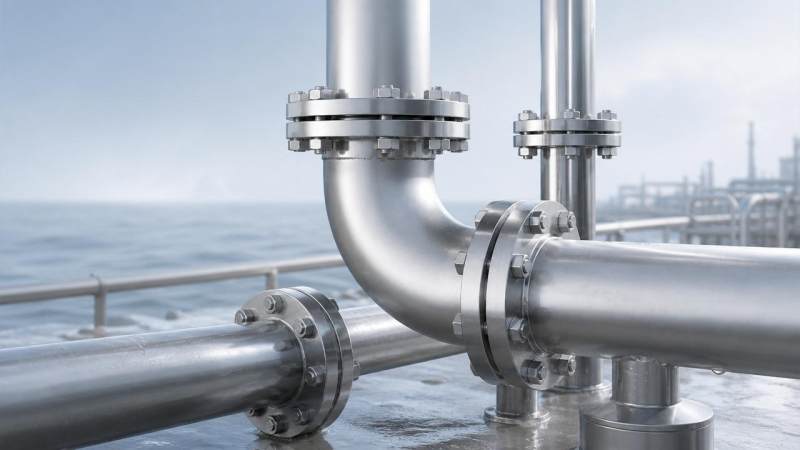
316 stainless steel pipe is an austenitic stainless steel product containing chromium, nickel, and molybdenum.
The molybdenum addition improves resistance to pitting and crevice corrosion in chloride-rich settings.
That difference matters near shorelines, ports, desalination plants, offshore platforms, and coastal processing sites.
Salt in the air does not need direct splash contact to create corrosion risk.
Windborne chlorides settle on metal surfaces and can attack weak points over time.
This is why indoor and sheltered areas near the coast still deserve careful material selection.
Why coastal exposure is different
- High chloride deposition from sea spray and humid air
- Frequent wet-dry cycles that accelerate localized attack
- Temperature variation that affects condensation on surfaces
- Crevices at joints, clamps, and supports that trap moisture
- Mixed contamination from industrial emissions and salts
In such conditions, material choice cannot rely on general indoor corrosion assumptions.
A coastal specification should evaluate actual exposure class, maintenance access, and design details.
How 316 Stainless Steel Pipe Compares With Lower-Cost Options
The main comparison is usually between carbon steel, galvanized steel, 304 stainless, and 316 stainless steel pipe.
Each option has a place, but the environment decides the true value.
Carbon steel often needs coatings, routine inspection, and periodic repair.
If coating damage occurs, corrosion can spread quickly in marine air.
Galvanized steel improves surface protection, but zinc layers can degrade faster near aggressive coastlines.
304 stainless performs well in many inland uses, yet it may stain or pit under sustained chloride exposure.
That is where 316 stainless steel pipe often justifies its premium.
Lifecycle Cost Matters More Than Purchase Price
The strongest case for 316 stainless steel pipe is usually economic, not cosmetic.
A lower-cost material may seem attractive during bidding.
However, coastal assets often face long service periods and difficult maintenance conditions.
Repair access can require shutdowns, scaffolding, lifting equipment, or marine logistics.
Key lifecycle cost components
- Initial material and fabrication cost
- Protective coating or finishing cost
- Inspection frequency and labor
- Downtime during repair or replacement
- Safety risk from corrosion-related failures
- Expected service life in actual exposure
When these factors are included, 316 stainless steel pipe often becomes cost-effective for critical lines and structural support systems.
This is especially true where replacement is disruptive or corrosion failure could affect operations.
Examples include seawater utility lines, exposed handrail supports, coastal plant piping, and outdoor process connections.
In broader steel packages, corrosion strategy should also match surrounding materials.
For cladding, roofing, or formed external components, DX51D Galvalume Steel Coil can complement stainless selections.
Its Aluzinc base offers strong corrosion resistance, heat resistance up to 315°C, and good formability.
Common specifications include DX51D, DX52D, SGLCC, and ASTM A792M grades.
It is widely used for structural use, roofing, commercial applications, appliances, industry, and food storage.
This kind of mixed-material planning can improve cost control without compromising coastal durability.
Typical Coastal Applications and Suitability
Not every line or component needs the same corrosion resistance level.
Material selection should match exposure severity, function, and maintenance consequences.
For splash zones and direct seawater contact, design review should go beyond grade selection.
Wall thickness, weld quality, drainage, and cleaning access remain essential.
Even the best stainless material can underperform if crevices and deposits are ignored.
Practical Specification and Sourcing Considerations
Choosing 316 stainless steel pipe is only the first step.
Project performance also depends on specification clarity and supplier capability.
Important checks before ordering
- Confirm the required standard, such as ASTM, EN, JIS, or GB.
- Verify chemical composition and mill test certificates.
- Check dimensions, wall thickness tolerance, and straightness.
- Review weld seam quality for welded pipe applications.
- Specify surface finish based on cleaning and appearance needs.
- Assess packaging for export transport and salt-air exposure during storage.
Reliable supply matters for large coastal projects with strict installation schedules.
Hongteng Fengda supports global construction and industrial projects with stable production and quality control.
Its capabilities cover structural steel, channels, beams, cold formed profiles, and customized steel solutions.
Compliance with ASTM, EN, JIS, and GB helps reduce sourcing uncertainty across international markets.
That matters when coastal projects require dependable lead times and consistent documentation.
Decision Guidance for Better Long-Term Value
So, is 316 stainless steel pipe worth the cost for coastal projects?
In many exposed or mission-critical applications, yes.
Its higher upfront cost is often offset by lower maintenance, better corrosion resistance, and longer service life.
The strongest value appears where failure consequences are expensive or dangerous.
However, not every component needs the same material grade.
A balanced package may combine 316 stainless steel pipe in critical zones with other corrosion-resistant steel products elsewhere.
Recommended next steps
- Map real chloride exposure by project area
- Separate critical and non-critical components
- Compare lifecycle cost instead of unit price only
- Request full technical documents from suppliers
- Align steel selection with design, fabrication, and maintenance plans
A careful specification today can prevent years of corrosion-related cost tomorrow.
When coastal durability is a core project requirement, 316 stainless steel pipe remains one of the most dependable choices in the steel sector.
Please give us a message


Please enter what you want to find