When evaluating materials for harsh marine environments, selecting the right ss tube is absolutely critical for ensuring long-term structural integrity.
While both 304 and 316 stainless steel grades offer robust corrosion resistance, their performance diverges significantly under continuous saltwater exposure.
Technical evaluators must carefully weigh factors such as pitting resistance, mechanical durability, and total lifecycle costs before finalizing procurement specifications.
This comprehensive guide compares 304 vs. 316 SS tubes, empowering engineers to determine which grade delivers optimal reliability for demanding offshore applications.
Understanding the Core Difference: Molybdenum and PREN Values
The fundamental difference between these two stainless steel grades lies in their specific chemical composition, particularly the addition of molybdenum.
The Grade 316 stainless steel contains approximately two to three percent molybdenum, which is entirely absent in the standard 304 formulation.
This specific alloying element dramatically enhances the overall ability of the material to resist localized corrosion in aggressive chloride environments.
To accurately quantify this critical resistance, engineers rely on the Pitting Resistance Equivalent Number, commonly referred to as the PREN value.
The standard PREN formula incorporates the specific percentages of chromium, molybdenum, and nitrogen to predict the pitting corrosion resistance capabilities.
A standard 304 ss tube typically yields a PREN value between 18 and 23, indicating moderate resistance to chloride attack.
Conversely, a 316 ss tube generally achieves a PREN value ranging from 24 to 32, signifying superior localized corrosion protection.
This mathematical difference directly translates to real-world performance when the materials face continuous exposure to harsh salt spray and seawater.
Nickel is another crucial element present in both grades, typically comprising eight to ten percent of the overall alloy composition.
This element stabilizes the austenitic crystal structure, providing excellent toughness and formability even at extremely low cryogenic service temperatures.
While both grades share similar nickel content, the precise balance of chromium and molybdenum dictates their specific localized corrosion behaviors.
Corrosion Mechanisms in Marine Environments
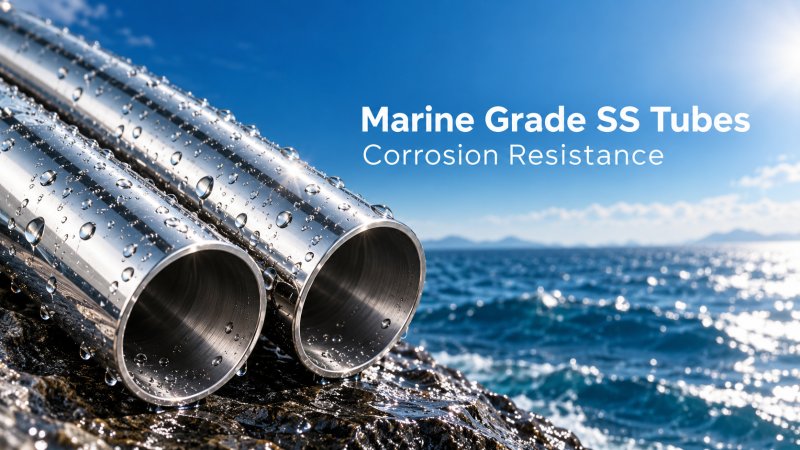
Marine environments present unique corrosion challenges that go far beyond simple uniform rusting on the exposed surface of structural metals.
Pitting corrosion is the most prevalent threat, occurring when chloride ions breach the passive oxide layer on the steel surface.
Once a microscopic pit initiates, it can propagate rapidly inward, severely compromising the structural wall thickness of an ss tube.
Grade 304 is highly susceptible to pitting in warm seawater, making it a risky choice for submerged or splash zone applications.
Grade 316, thanks to its molybdenum content, stabilizes the passive film and effectively repels chloride ions to prevent pit initiation.
Crevice corrosion is another critical failure mode, particularly in joints, flanges, and under marine biofouling organisms on the ss tube.
In these oxygen-depleted gaps, the local chemistry becomes highly acidic, rapidly accelerating the breakdown of the protective passive oxide layer.
While 304 stainless steel will often fail in crevices even in mild marine atmospheres, 316 offers significantly improved crevice corrosion resistance.
However, technical evaluators must note that 316 is not entirely immune to crevice corrosion if seawater temperatures exceed normal ambient levels.
Stress corrosion cracking also poses a severe risk to structural components subjected to tensile stresses in warm, chloride-rich marine environments.
Both grades can suffer from this sudden brittle failure, but the threshold time and temperature for 316 are substantially higher.
Galvanic corrosion presents another significant risk when an ss tube is electrically connected to a less noble metal in seawater.
If carbon steel fasteners are used with stainless structural components, the carbon steel will corrode rapidly to protect the stainless steel.
However, if the surface area of the stainless steel is large compared to the carbon steel, the galvanic effect accelerates.
Evaluators must ensure that all connected materials are galvanically compatible or properly insulated to prevent accelerated and severe localized corrosion failures.
Marine biofouling also plays a critical role in the corrosion process by creating localized oxygen concentration cells on the metal surface.
Marine Zoning: Where to Use 304 vs. 316 SS Tube
Selecting the appropriate stainless steel grade requires a detailed understanding of the specific marine exposure zone for your structural project.
The upper marine atmosphere zone, located above the splash area, experiences salt spray but no direct contact with liquid seawater.
In these relatively mild conditions, a 304 ss tube often provides adequate performance and exceptional cost-efficiency for structural steel frameworks.
However, the splash zone is the most aggressive environment, where steel is continuously wetted by oxygen-rich saltwater and subjected to impact.
For any structural component in the splash zone, specifying a 316 ss tube is absolutely mandatory to prevent rapid localized corrosion.
In the tidal and submerged zones, oxygen levels are lower, but the continuous presence of chlorides still demands high alloy content.
Here, 316 stainless steel is the baseline requirement, though super austenitic or duplex grades might be needed for deeper offshore structures.
When designing mooring systems or marine crane structures for these zones, integrating durable components is essential for overall system reliability.
For instance, pairing a 316 ss tube structural mast with a Hot dipped Galvanized Steel Wire Rope ensures comprehensive corrosion protection across the entire rigging assembly.
This holistic approach prevents galvanic issues and ensures that no single component becomes the weak link in the marine structure.
It is also vital to distinguish between inland marine environments, such as the Great Lakes, and open ocean offshore applications.
Inland waters generally have lower chloride concentrations and cooler temperatures, making a 304 ss tube a much more viable option.
Conversely, open ocean structures face higher salinity, warmer temperatures, and continuous wave action, demanding the superior protection of 316 stainless steel.
Temperature significantly accelerates corrosion kinetics, meaning a grade that performs well in cold Arctic waters might fail rapidly in tropical seas.
For tropical offshore platforms, engineers often need to look beyond standard 316 and consider duplex or super austenitic stainless steel grades.
Lifecycle Cost and Maintenance Considerations
Technical evaluators and project managers must look beyond the initial procurement price when comparing 304 and 316 stainless steel tubes.
The upfront material cost for a 316 ss tube is typically twenty to thirty percent higher than its 304 counterpart.
However, this initial premium is quickly offset if the project is located in a highly corrosive marine or offshore environment.
Using 304 in a splash zone will inevitably lead to premature pitting, requiring expensive emergency maintenance or complete structural replacement.
The cost of offshore maintenance, including scaffolding, specialized labor, and vessel downtime, vastly exceeds the initial savings of choosing 304.
Conversely, specifying 316 where 304 would suffice represents an unnecessary capital expenditure that inflates the overall project budget significantly.
Therefore, accurate environmental zoning and precise material selection are absolutely critical for optimizing the total lifecycle cost of marine infrastructure.
By matching the correct ss tube grade to the specific exposure zone, engineers ensure maximum return on investment and structural longevity.
Beyond direct financial costs, technical evaluators must also consider the environmental impact of premature material failure and frequent structural replacements.
Manufacturing and transporting replacement ss tube components generates significant carbon emissions, undermining the sustainability goals of modern marine construction projects.
Selecting the correct grade initially minimizes these environmental impacts by ensuring the structure lasts for its entire intended design lifecycle.
Supply chain reliability is another practical consideration, as 304 is generally more readily available than 316 from global steel manufacturers.
However, reputable structural steel manufacturers can provide both grades with consistent quality, ensuring that project lead times are not unnecessarily delayed.
Fabrication and Welding Implications for Marine Projects
The fabrication process significantly impacts the final corrosion resistance of any stainless steel component used in highly demanding marine applications.
Welding can cause chromium carbide precipitation in the heat-affected zones, locally depleting chromium and reducing overall corrosion resistance dramatically.
To mitigate this risk, technical evaluators should specify low-carbon variants like 304L or 316L for any ss tube requiring extensive welding.
Post-weld treatments, such as pickling and passivation, are also essential to restore the protective oxide layer on the welded ss tube.
Without proper passivation, the weld zones quickly become the primary initiation sites for pitting and crevice corrosion in marine environments.
Furthermore, proper handling and storage protocols must be enforced to prevent carbon steel contamination, which can ruin the stainless properties.
Proper cutting and machining practices are equally important to prevent carbon steel contamination during the fabrication of the ss tube.
Tools used for cutting carbon steel must never be used on stainless steel without thorough cleaning, as iron particles cause rust.
Surface finish also influences corrosion resistance, as a smooth, polished finish on an ss tube reduces the areas where chlorides can accumulate.
Rough surfaces or mill scale can trap moisture and contaminants, acting as initiation sites for pitting even in 316 stainless steel.
Conclusion: Making the Right Material Choice
Selecting between 304 and 316 stainless steel for marine environments is not a matter of personal preference, but of engineering science.
The 304 ss tube remains an excellent, cost-effective choice for mild marine atmospheres where direct saltwater contact is strictly avoided.
However, for splash zones, tidal areas, and submerged applications, the superior chloride resistance of the 316 ss tube is non-negotiable.
Technical evaluators must carefully assess the specific exposure conditions, fabrication requirements, and total lifecycle costs before finalizing their material specifications.
By aligning the material grade with the actual environmental threats, project managers can deliver safe, durable, and cost-efficient marine structures.
Ultimately, understanding these metallurgical differences ensures that your structural steel investments withstand the relentless demands of the harsh marine environment.
Regular inspection and maintenance schedules should be established based on the specific grade and environmental zone to catch early corrosion signs.
Implementing a robust quality assurance program during manufacturing ensures that every ss tube meets the stringent requirements of international marine standards.
Collaboration between material suppliers, fabricators, and end-users is essential to optimize the design and extend the service life of offshore assets.
As marine engineering projects become more ambitious, the demand for high-performance materials like 316 stainless steel will continue to grow steadily.
Making informed, data-driven material selections today will guarantee the structural integrity and operational success of marine infrastructure for decades to come.
Please give us a message


Please enter what you want to find