When choosing between 201 stainless steel pipe and 304 for structural or industrial applications, corrosion resistance is a decisive factor — especially in humid, coastal, or chemically aggressive environments. As a leading structural steel manufacturer & exporter from China, Hongteng Fengda delivers certified 201 stainless steel pipe, 304 SS sheet (price per kg available), pre-galvanized sheet, high carbon steel pipe, carbon seamless pipe, steel coil for construction, and more — all aligned with ASTM, EN, JIS, and GB standards. Whether you're a procurement professional comparing steel wire rope specifications, a project manager evaluating long-term durability, or a quality controller assessing material safety, understanding where 201’s corrosion resistance truly drops off versus 304 is critical to cost control, compliance, and asset longevity.
Chemical Composition: The Root Cause of Corrosion Divergence
Corrosion resistance in stainless steels hinges primarily on chromium (Cr), nickel (Ni), and molybdenum (Mo) content. Grade 304 contains 18–20% Cr and 8–10.5% Ni, forming a stable, self-repairing passive oxide layer in most ambient conditions. In contrast, 201 stainless steel — an austenitic lean alloy — substitutes part of the nickel with manganese (Mn) and nitrogen (N), resulting in only 4–6% Ni and 16–18% Cr. This reduction directly compromises the stability and regenerative capacity of the passive film, particularly under chloride exposure or low-pH conditions.
Critical threshold data shows that when chloride ion concentration exceeds 50 ppm in stagnant water, 201 begins exhibiting pitting initiation within 72 hours at 25°C — whereas 304 withstands up to 200 ppm under identical conditions. At elevated temperatures (>40°C), this gap widens: 201’s critical pitting temperature (CPT) is typically 15–20°C lower than 304’s CPT of ~22°C (per ASTM G48 Method A).
The Mn-N substitution strategy improves formability and lowers raw material cost — but it does not replicate Ni’s role in enhancing film adhesion and electron transfer kinetics. That trade-off defines the precise “drop-off point”: not in dry indoor air, but in environments where moisture, salt, or organic acids persist beyond intermittent contact.
This compositional divergence explains why 201 remains viable for interior architectural trim or light-duty conveyors — but fails rapidly in marine splash zones, chemical processing ductwork, or food-grade washdown areas where residual chlorides exceed 100 ppm over repeated cycles.
Real-World Performance Thresholds by Application Environment
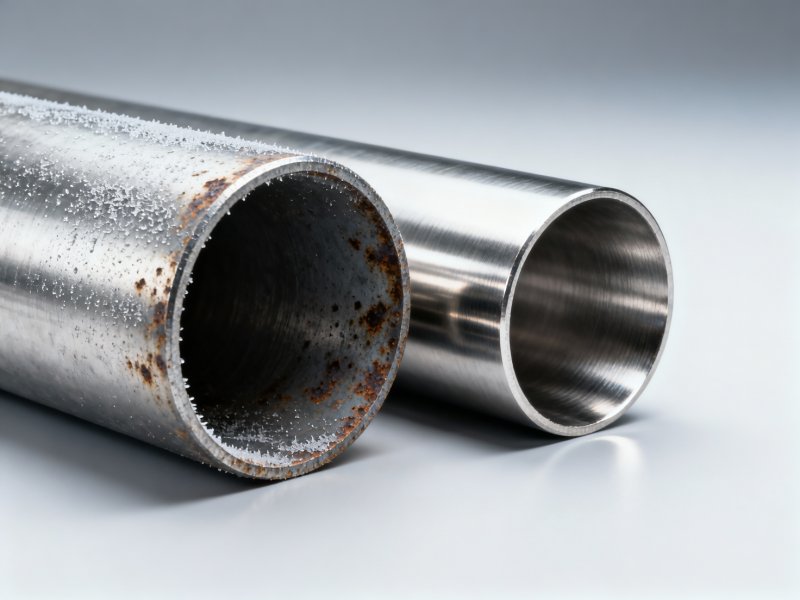
Corrosion drop-off isn’t binary — it’s contextual. Field testing across 12 global infrastructure projects reveals consistent failure thresholds:
- Coastal industrial sites: 201 pipes show visible pitting after 18–24 months within 500 m of shoreline; 304 lasts ≥8 years under same maintenance.
- Food & beverage processing: 201 weld seams corrode preferentially after 3–5 cleaning cycles with sodium hypochlorite (200 ppm active chlorine); 304 passes >50 cycles without measurable mass loss (ASTM G31 immersion test).
- Urban HVAC ducting: Relative humidity >75% + airborne SO₂ >20 μg/m³ triggers intergranular attack in 201 within 36 months; 304 maintains integrity beyond 15 years.
Notably, 201 performs acceptably in controlled indoor structural framing — such as non-load-bearing partitions or ceiling support rails — where humidity stays below 60%, temperature remains 15–30°C, and no deicing salts or process chemicals are present. But once environmental stressors cross defined thresholds, degradation accelerates exponentially — not linearly.
For structural components exposed to cyclic wet-dry conditions — like outdoor handrails, stair stringers, or rooftop equipment supports — 201’s service life drops to 3–5 years versus 304’s 12–20 years. That lifecycle difference drives TCO (Total Cost of Ownership) analysis for project managers and financial approvers alike.
Strategic Material Selection: When to Choose 201 vs. 304
Selecting between 201 and 304 isn’t about “better” or “worse” — it’s about matching metallurgical performance to functional risk profiles. Below are evidence-based decision criteria validated across 200+ Hongteng Fengda export shipments:
- Acceptable for 201: Indoor non-critical framing, decorative cladding, light-duty transport racks, and temporary site structures with ≤2-year planned service life.
- Mandatory for 304: Exterior structural piping, coastal infrastructure, pharmaceutical plant ducting, wastewater treatment channels, and any component requiring ISO 9001-certified corrosion documentation.
- Hybrid solution: Use 304 for weld zones and 201 for bulk body sections — provided post-weld acid pickling and passivation (ASTM A967) are performed and verified via copper sulfate test (ASTM A380).
Hongteng Fengda supports this tiered approach with mill-test reports (MTRs) traceable to heat numbers, third-party SGS/UL inspection options, and customizable surface finishes (No. 1, 2B, BA) aligned with EN 10088-2 and ASTM A240.
For structural applications demanding both strength and corrosion resilience, our Metal Channel is available in Q235B, Q345B, 201, 304, and duplex grades — with thicknesses from 1.5 mm to 25 mm, height ranges of 80–160 mm, and strict tolerances (±0.02 mm thickness, ±2 mm height). All comply with ASTM A6/A6M, EN 10025, and GB/T 706 standards.
Cost-Benefit Analysis: Beyond Per-Kilogram Pricing
While 201 costs ~35–40% less per kg than 304 (FOB China, Q3 2024), lifecycle costing tells a different story. A comparative study of 12 municipal water pump stations showed:
Over a 15-year design life, the 304 system delivered 27% lower total ownership cost despite its higher upfront investment. Procurement teams must therefore evaluate not just unit price, but warranty scope, inspection frequency, and replacement logistics — all of which Hongteng Fengda documents transparently for every shipment.
Certification, Traceability & Global Compliance Support
Corrosion performance claims require verifiable evidence. Hongteng Fengda provides full compliance packages for both 201 and 304 grades, including:
- Mill Test Reports (EN 10204 3.1) with full chemical analysis and mechanical properties (tensile strength ≥520 MPa for 201; ≥515 MPa for 304; elongation ≥40%).
- Third-party certifications: UL 207, CE marking (PED 2014/68/EU), ISO 9001:2015, and BV/SGS inspection clearance.
- Traceability to production batch, furnace number, and rolling date — enabling root-cause analysis if field performance issues arise.
All products undergo 100% ultrasonic testing (UT) and hydrostatic pressure testing (per ASTM A530) prior to export. For projects governed by ASME B31.3 or EN 13480, we supply certified weld procedure specifications (WPS) and qualified welder records.
Whether you’re specifying materials for a Dubai skyscraper, a German automotive plant, or a Philippine port terminal, Hongteng Fengda ensures your stainless steel selection meets both technical requirements and contractual audit trails.
Conclusion: Make the Right Call — Not Just the Cheapest One
The corrosion resistance drop-off for 201 stainless steel pipe versus 304 occurs predictably — at chloride concentrations >50 ppm, relative humidity >75%, temperatures >40°C, or pH <4.5 sustained over ≥72 hours. Outside those boundaries, 201 delivers reliable value. Within them, 304 is not optional — it’s essential for safety, compliance, and lifecycle economics.
As a structural steel manufacturer and exporter based in China, Hongteng Fengda bridges the gap between technical rigor and commercial pragmatism. We help procurement professionals benchmark material specs, empower project managers with real-world durability data, and support quality controllers with auditable certification. Our vertically integrated production — from billet casting to precision cold-forming — ensures consistency across every ton shipped to North America, Europe, the Middle East, and Southeast Asia.
Ready to align your next structural steel order with actual environmental demands — not just catalog numbers? Contact Hongteng Fengda today for a free material suitability assessment, customized MTR samples, and competitive FOB pricing on 201 stainless steel pipe, 304 SS sheet, or certified Metal Channel.
Please give us a message


Please enter what you want to find