Choosing the right 2 inch stainless steel pipe wall thickness directly affects strength, pressure performance, corrosion resistance, and project cost. For technical evaluators, understanding how schedule, application conditions, and material standards work together is essential to making a reliable selection. This guide outlines the key factors to compare so you can specify the most suitable pipe for industrial, construction, or manufacturing needs.
In steel procurement, wall thickness is not a minor dimensional detail. It influences allowable pressure, service life, weldability, fabrication cost, and transport weight. For projects in construction, processing plants, machinery manufacturing, and pipeline systems, a poor specification can lead to overdesign, underperformance, or avoidable purchasing risk.
Technical buyers also need to balance stainless pipe requirements with broader structural steel planning. When a project includes both pressure piping and structural members, standard alignment, delivery coordination, and supplier consistency become important. That is where an experienced Chinese structural steel manufacturer and exporter such as Hongteng Fengda can support specification review, quality control, and stable supply across multiple steel categories.
Why Wall Thickness Matters in a 2 Inch Stainless Steel Pipe Selection
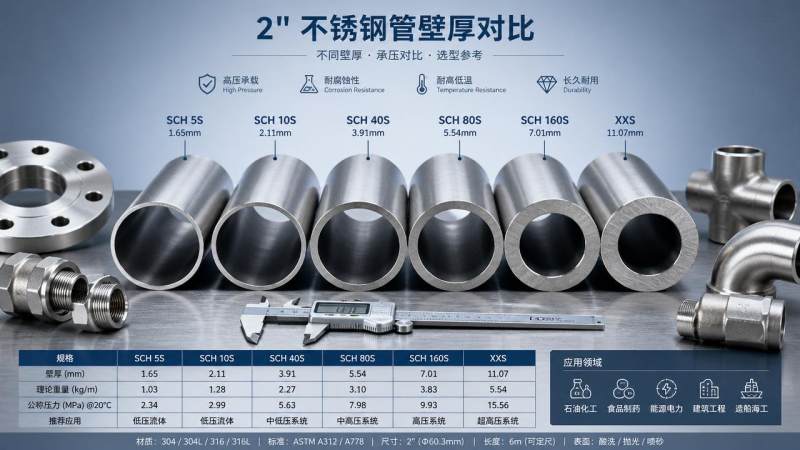
When engineers refer to a 2 inch stainless steel pipe, they usually mean a nominal pipe size rather than an exact outside diameter of 2.000 inches. In many common standards, NPS 2 pipe has an outside diameter of 2.375 inches, while the inside diameter changes according to wall thickness or schedule. That difference directly affects flow, pressure capacity, and weight per meter.
For example, moving from a lighter schedule such as Sch 10 to a heavier schedule such as Sch 40 or Sch 80 can significantly increase wall section and reduce the internal passage area. In applications carrying liquids, gases, steam, or corrosive media, this change may improve mechanical safety but also alter pump load, pressure drop, and total installed cost.
Four technical impacts of wall thickness
- Pressure resistance: thicker walls usually allow higher working pressure under the same material grade and temperature range.
- Corrosion allowance: a larger wall section can provide extra service margin in systems with internal or external corrosion exposure.
- Mechanical robustness: thicker pipes perform better against impact, vibration, and local handling damage during fabrication or installation.
- Cost and weight: heavier schedules increase raw material usage, transport weight, and cutting or welding time.
Common project consequences
If a wall is too thin, the project may face premature wear, deformation, or difficulty meeting design pressure. If it is too thick, the buyer may pay 15% to 40% more in steel and fabrication cost than necessary, depending on length, fitting count, and handling method. The right choice comes from matching service conditions to the schedule instead of defaulting to the heaviest option.
The table below summarizes how typical thickness decisions affect technical and commercial outcomes in a 2 inch stainless steel pipe specification process.
For technical evaluators, the practical lesson is clear: thickness should be treated as a functional variable linked to service pressure, corrosion allowance, and fabrication conditions, not just a purchase line item.
How to Compare Schedules, Standards, and Service Conditions
A reliable 2 inch stainless steel pipe decision usually starts with three checkpoints: schedule, material standard, and operating environment. Evaluating these three together reduces mismatch risk far more effectively than comparing price alone.
1. Start with the schedule requirement
Schedules such as Sch 5, Sch 10, Sch 40, and Sch 80 are widely used to define wall thickness ranges. In lighter-duty transfer lines, Sch 10 may be sufficient. In higher pressure or mechanically demanding systems, Sch 40 or Sch 80 is often reviewed first. However, the final choice should always follow design calculations, code requirements, and site conditions.
2. Check temperature and corrosion exposure
At temperatures from ambient 20°C up to 200°C or more, pressure capacity and corrosion behavior can change depending on medium and alloy. Chloride-containing environments, cyclic wet-dry exposure, and chemical cleaning procedures may justify a higher corrosion allowance or a different stainless grade. In these cases, wall thickness cannot be separated from material selection.
3. Review code and end-use standard compatibility
Global buyers often need compliance across ASTM, ASME, EN, JIS, or GB systems. A pipe acceptable for one regional project may need additional test documents or dimensional confirmation for another. Technical review should include mill certificates, heat numbers, dimensional tolerances, and test scope before purchase approval.
The comparison below helps evaluators identify which conditions usually push a 2 inch stainless steel pipe toward a lighter or heavier wall specification.
This kind of matrix is useful during bid evaluation because it converts abstract specification language into procurement logic. It also helps teams justify why one schedule offers the best balance between life-cycle performance and project budget.
Key Selection Steps for Technical Evaluators
A structured review process can shorten decision cycles and reduce revision work. In many industrial procurement teams, a 5-step evaluation method is enough to screen most 2 inch stainless steel pipe requirements before requesting a final quotation.
Step 1: Confirm the actual service duty
Define fluid type, design pressure, operating temperature, corrosion risk, and service life target. A line expected to run for 10 to 20 years in a chemical environment should not be reviewed with the same assumptions as a short-term utility connection inside a controlled plant building.
Step 2: Match the pipe schedule to code calculations
Engineering calculations should determine the minimum required wall. Procurement should then compare available commercial schedules above that threshold. This avoids buying a nonstandard thickness that complicates sourcing, lead time, and fitting compatibility.
Step 3: Check joining and fabrication method
If the system uses extensive welding, beveling, or field fitting, wall thickness affects heat input, joint preparation, and productivity. In modular fabrication, a heavier wall may increase shop hours. In high-vibration service, however, it may still be the safer option. Evaluators should review both installation method and service demand together.
Step 4: Verify test and inspection requirements
Inspection scope may include dimensional checks, PMI where required, hydrostatic testing, surface finish review, and certificate verification. A typical acceptance plan may involve 4 to 6 control points from raw material traceability to packing inspection before shipment.
Step 5: Evaluate total sourcing efficiency
Buyers should look beyond unit price. Lead time, packaging, document readiness, export experience, and mixed-product coordination often affect the real project outcome. A supplier able to support both stainless piping needs and structural steel supply can simplify communication and reduce schedule gaps.
Related structural steel coordination
Many projects that purchase stainless pipe also require carbon or structural tube for supports, frames, skids, and machinery bases. In such cases, procurement teams often prefer a supplier network that can align specifications across multiple steel products. For structural applications, Tube Carbon Steel can be relevant where project designs call for grades such as S355JRH, S355J0H, S275J2H, S355J2H, S275J0H, or S355K2H.
These structural tubes are commonly used in bridges, ships, power station equipment, lifting and transportation machinery, machinery manufacturing, chemical plants, vessels, pipeline engineering, and general mechanical engineering. Available forms include seamless sizes from 1/4" to 36", welded sizes from 21.3mm to 3620mm, wall thickness ranges of 1.25mm to 50mm for seamless and 1.65mm to 65mm for welded products, with standard lengths from 3 to 12 meters.
For evaluators comparing load-bearing support materials, S355 steel tube options are valued for good welding performance, plasticity, toughness, high strength, and the ability to improve stiffness while reducing unnecessary structural weight. Compliance can be aligned with EN, DIN, JIS, ASTM, BS, ASME, and AISI frameworks depending on project documentation needs.
Common Specification Mistakes and How to Avoid Them
Even experienced teams can make avoidable errors when specifying a 2 inch stainless steel pipe. Most problems happen when dimensions, schedules, and operating assumptions are carried over from previous projects without a fresh technical check.
Mistake 1: Using nominal size as if it were exact size
A 2 inch designation does not mean every associated dimension is 2 inches. Evaluators should confirm outside diameter, wall thickness, and resulting inside diameter before approving design flow calculations or fittings.
Mistake 2: Selecting the same schedule for every service
Standardizing all lines to one heavy schedule may seem convenient, but it can increase steel consumption, support loads, and fabrication hours. On the other hand, choosing one light schedule everywhere may create pressure or durability issues. Service-based segmentation is usually the better approach.
Mistake 3: Ignoring corrosion allowance in real plant conditions
Even stainless steel is not immune to all environments. Chemical splash zones, coastal atmospheres, crevice conditions, and cleaning cycles can change corrosion behavior over time. A technical review should include both internal medium and external exposure, especially in 24-hour operating facilities.
Mistake 4: Evaluating cost only by ton price
A cheaper line item can become more expensive after rework, delayed documents, dimensional mismatch, or inconsistent quality. In cross-border purchasing, lead time reliability and inspection readiness can be as important as base material cost.
The table below highlights practical checks that help reduce these common risks during sourcing and technical approval.
In many international projects, these checks save more time than repeated price negotiations. They also give technical evaluators stronger justification when recommending one 2 inch stainless steel pipe option over another.
Supplier Evaluation for Industrial and Construction Projects
Once the wall thickness is technically defined, supplier assessment becomes the next control point. For B2B buyers, the right supplier should provide more than stock availability. It should support specification clarity, stable production, and predictable delivery.
What technical evaluators should ask
- Can the supplier confirm standards such as ASTM, EN, JIS, or GB according to project documents?
- Can it maintain dimensional consistency across batches and lengths, such as 3 to 12 meters where relevant?
- Can it provide inspection records, marking traceability, and export packing suitable for long-distance shipment?
- Can it coordinate related steel items for support structures, fabricated components, or OEM steel parts?
Why integrated steel sourcing matters
Hongteng Fengda serves global construction, industrial, and manufacturing projects with structural steel products and customized solutions. For buyers managing multiple line items, integrated sourcing can reduce communication loops, lower document inconsistency risk, and improve shipment planning across standard and OEM products.
The company’s experience in angle steel, channel steel, steel beams, cold formed steel profiles, and customized structural steel components is useful when piping systems also require supports, frames, or machinery structures. Consistent quality control and familiarity with ASTM, EN, JIS, and GB standards help technical teams align material review across regions including North America, Europe, the Middle East, and Southeast Asia.
For project teams under time pressure, dependable lead times can be just as important as material properties. A well-prepared supplier can help reduce sourcing risk, control costs, and keep engineering, fabrication, and site installation moving within the planned cycle.
Final Guidance for Specifying the Right Pipe
The best wall thickness for a 2 inch stainless steel pipe is the one that matches actual operating pressure, corrosion conditions, fabrication method, and project budget without adding unnecessary weight or risk. Technical evaluators should review at least 4 core factors every time: schedule, service environment, standards compliance, and sourcing reliability.
A careful specification process helps avoid two expensive outcomes at once: undersized pipe that may fail early, and oversized pipe that increases total installed cost. In steel-intensive projects, that balance has a direct effect on procurement efficiency and long-term operating performance.
If your project involves stainless piping together with structural steel supports, frames, or customized fabricated members, working with a responsive manufacturing partner can simplify the process. Contact Hongteng Fengda to discuss your specifications, request a tailored solution, or review related steel products for industrial, construction, and manufacturing applications.
Please give us a message


Please enter what you want to find