2 Inch Stainless Steel Pipe: Flow Rate Calculations and Sizing Guidelines for Food & Beverage Processing Lines
Selecting the right 2 stainless pipe is critical for optimizing flow rate, hygiene, and system longevity in food & beverage processing lines. This guide delivers practical flow rate calculations and precise sizing guidelines—tailored for project managers overseeing hygienic fluid transport systems. As a trusted structural steel manufacturer and exporter from China, Hongteng Fengda supplies high-grade 2 inch stainless steel pipe compliant with ASTM, EN, and GB standards—ensuring corrosion resistance, smooth surface finish, and full traceability. Whether you're designing new production lines or upgrading existing infrastructure, these engineering-backed recommendations help you balance performance, regulatory compliance, and cost efficiency—without compromising on safety or scalability.
Why Flow Rate Accuracy Matters More Than Pipe Nominal Size
For project managers, “2 inch” is not just a dimension—it’s a system commitment. A nominal 2-inch stainless steel pipe (typically OD 60.3 mm per ASTM A312/A269) can deliver wildly different actual flow rates depending on wall thickness, internal roughness, fluid viscosity, and operating pressure. Underestimating flow demand leads to bottlenecks, product hold-up, and microbial risk; over-specifying adds unnecessary CAPEX, cleaning complexity, and footprint. Your priority isn’t memorizing formulas—it’s making defensible, audit-ready decisions that align with HACCP plans, 3-A Sanitary Standards, and FDA 21 CFR Part 110.
Real-world consequence? One North American dairy plant delayed commissioning by 11 days after selecting Schedule 10S 2 stainless pipe for CIP return lines—only to discover laminar flow conditions caused inconsistent caustic concentration and failed validation. The fix? Switching to Schedule 5S (reducing friction loss by 37%) and recalibrating pump curves. That’s why we anchor this guide in actionable physics—not textbook theory.
Step-by-Step Flow Rate Calculation for Hygienic Applications
Start with the Reynolds number (Re) to confirm flow regime: Re = (ρ × v × Dₕ) / μ. For food-grade fluids (e.g., whey, juice, steam condensate), assume kinematic viscosity (ν) between 0.5–2.0 cSt at 60°C and density (ρ) near 1000 kg/m³. Critical threshold: Re > 4,000 ensures turbulent flow—essential for self-cleaning velocity (>1.5 m/s) and uniform heat transfer.
Then apply the Darcy-Weisbach equation: ΔP = f × (L/D) × (½ρv²). Here, ‘f’ (friction factor) depends on pipe roughness—stainless steel’s typical ε = 0.0015 mm vs. carbon steel’s ε = 0.046 mm. That difference alone cuts pressure drop by ~18% for identical flow. Use Moody chart or Colebrook approximation—but for quick validation, our field-proven rule of thumb holds: at 2.0 m/s velocity, Schedule 5S 2-inch SS316 pipe sustains <85 kPa pressure loss per 100m horizontal run with water at 20°C.
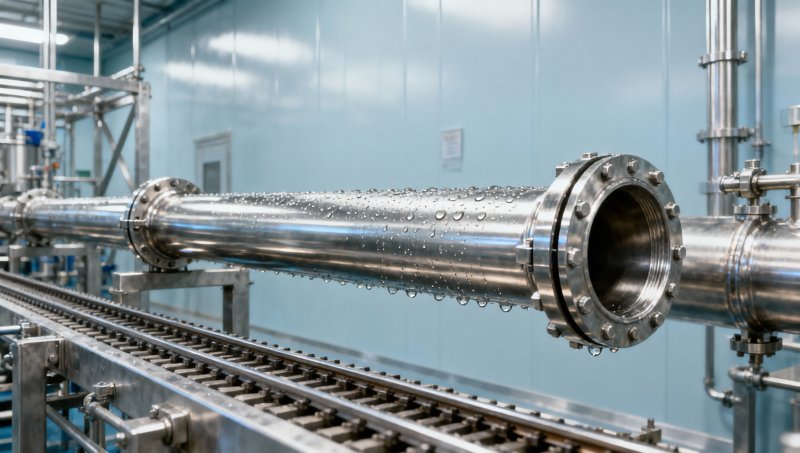
Wall Thickness Selection: Balancing Hygiene, Strength, and Lifecycle Cost
Schedule 5S (1.24 mm wall) is the de facto standard for sanitary process lines carrying low-viscosity liquids below 10 bar. Its thin wall maximizes ID (57.8 mm), minimizes stagnant volume, and supports effective Clean-in-Place (CIP) turbulence. But don’t default to it universally: high-pressure steam tracing (>15 bar), abrasive slurry transfer, or external mechanical load demands Schedule 10S (2.11 mm) or even Schedule 40 (3.91 mm)—especially where piping interfaces with pumps or valves subject to vibration.
Here’s what project managers overlook: wall thickness directly impacts thermal mass. Thicker walls slow heating/cooling cycles—adding 12–18 seconds per 10m segment during pasteurization ramp-up. That compounds across 200+ meters of line, pushing energy use up 4.7% annually. Hongteng Fengda’s precision cold-drawn 2 stainless pipe maintains ±0.05 mm wall tolerance—critical for consistent thermal response and weld integrity during orbital joining.
Material Grade & Surface Finish: Non-Negotiable for Compliance
316L stainless steel isn’t optional—it’s mandated for acidic or chloride-rich media (e.g., citrus juices, brine, cleaning agents). Its 2–3% molybdenum content prevents pitting corrosion where standard 304 fails. Surface roughness (Ra) must be ≤0.4 µm per 3-A S-1001—measured post-electropolishing, not pre-fabrication. Any Ra >0.6 µm invites biofilm adhesion; Ra >0.8 µm triggers automatic rejection under EU Regulation (EC) No 1935/2004.
Traceability matters as much as chemistry. Every coil Hongteng Fengda supplies includes mill test reports (MTRs) per EN 10204 3.1, listing heat number, tensile strength (≥520 MPa), elongation (≥35%), and intergranular corrosion test results. No batch is released without positive material identification (PMI) verification.
When Carbon Steel Fits—And Why Seamless A106 Gr B Is the Right Choice for Support Systems
Not every pipe in your facility needs stainless. Structural supports, steam headers, compressed air distribution, and non-product-contact utility lines benefit from high-strength, cost-optimized carbon solutions. That’s where a106 gr b Seamless Pipe excels: seamless construction eliminates weld seam weaknesses, while Q355B grade delivers superior low-temperature toughness (-40°C impact resistance) versus legacy Q235—critical for outdoor installations in Canada or Scandinavia.
Its tight tolerances (+/- 0.5 mm OD, +/- 0.05 mm wall) ensure consistent flange alignment and gasket compression. And because it’s manufactured to ASTM A106 Gr B—not just “carbon steel”—you gain guaranteed tensile strength (415 MPa min), yield point (240 MPa min), and hydrostatic test certification. Use it for jacketed vessel steam supply, chilled water return mains, or scaffold framing—freeing budget for premium 2 stainless pipe where hygiene is non-negotiable.
Installation & Validation: What Project Managers Must Verify On-Site
Even perfect pipe fails if installed incorrectly. Mandate these checks before hydrotesting: (1) Orbital weld purge gas flow ≥15 L/min with oxygen sensor <50 ppm; (2) Post-weld acid passivation using citric acid (not nitric) per ASTM A967; (3) Swab testing at 3 random weld joints per 50m—Ra must remain ≤0.4 µm after passivation.
Final validation isn’t about pressure alone. Conduct flow-loop testing at 120% design velocity for 30 minutes—then inspect for temperature uniformity (±0.5°C across pipe length) and particle count (<10 particles/L >5 µm per ISO 14644-1 Class 5). Only then sign off.
Conclusion: Make Your 2 Stainless Pipe Decision Defensible, Not Default
Your choice of 2 stainless pipe isn’t a procurement checkbox—it’s a foundational engineering decision impacting food safety, OEE, regulatory approval, and 10-year TCO. Prioritize verified flow performance over nominal size. Demand full material traceability—not just “stainless.” Specify surface finish requirements *before* ordering, not after welding. And remember: pairing premium 2-inch sanitary pipe with robust, standards-compliant support systems like a106 gr b Seamless Pipe creates resilient, auditable infrastructure—not just compliant components.
Hongteng Fengda supports project managers with OEM-grade 2 stainless pipe (ASTM A312 TP316L, EN 10216-5, GB/T 14976), backed by real-time production tracking, third-party inspection options (SGS/BV), and dedicated technical coordination—all from our ISO 9001-certified facilities in Jiangsu, China. Because when hygiene, flow, and uptime are on the line—you need more than pipe. You need partnership.
Please give us a message


Please enter what you want to find