2 Inch Stainless Steel Pipe Cost Breakdown: Material, Fabrication, and Long-Term Maintenance Implications
The true cost of a 2 inch stainless steel pipe isn’t captured by the unit price on a quotation sheet. For procurement professionals sourcing structural steel from China—especially for construction, industrial piping, or equipment integration—the upfront material cost represents only one layer of financial exposure. What determines long-term value is how material grade, fabrication requirements, and maintenance behavior interact across the asset’s lifecycle. A pipe quoted at $8.50/kg may deliver lower total cost than one at $6.20/kg—if its corrosion resistance eliminates replacement within five years, avoids downtime in critical process lines, or reduces inspection frequency in regulated environments.
Material grade selection drives over 60% of the initial cost variance—and it’s where procurement decisions most frequently misalign with application risk. A 2 inch pipe in ASTM A312 TP304 meets basic corrosion resistance but degrades rapidly under chloride exposure, common in coastal infrastructure or chemical processing. Switching to TP316 adds ~25–35% to raw material cost, yet extends service life by 3–5× in those same conditions. That premium isn’t overhead—it’s insurance against unplanned shutdowns, weld repairs, or regulatory non-compliance. Buyers who prioritize lowest landed cost often overlook that TP316’s molybdenum content (2–3%) fundamentally alters passivation stability, not just “better rust resistance.” This isn’t incremental improvement; it’s a threshold shift in electrochemical behavior under stress-corrosion conditions.
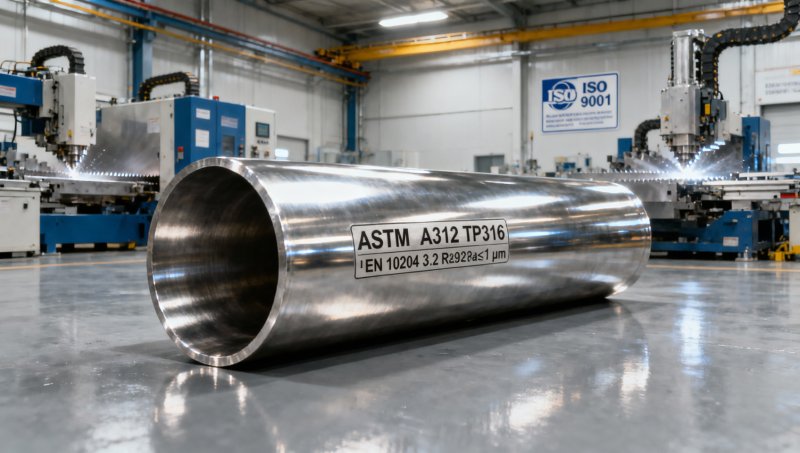
Fabrication complexity compounds cost unpredictability—not linearly, but exponentially with specification tightness. A standard 2 inch seamless pipe (ASTM A312, Schedule 40) carries predictable tolerances: ±12.5% wall thickness, ±1% OD. But when engineering specs require tighter OD control (±0.5 mm), enhanced surface finish (Ra ≤ 0.8 µm), or post-weld heat treatment (PWHT) per ASME BPVC Section IX, fabrication time increases 30–70%, and rejection rates climb. Chinese mills with ISO 9001-certified QA/QC processes handle these demands consistently—but only if the purchase order explicitly references test reports (e.g., PMI verification, hydrostatic test records, intergranular corrosion testing per ASTM A262 Practice E). Generic “stainless steel pipe” POs invite substitution risk; referencing EN 10217-7 or GB/T 14976-2015 with full traceability clauses ensures alignment between quoted cost and delivered conformity.
Long-term maintenance implications are rarely priced into procurement models—but they dominate lifecycle economics. A 2 inch stainless pipe installed in a food-grade CIP line faces repeated thermal cycling and aggressive cleaning agents. Here, surface roughness matters more than tensile strength: Ra > 1.6 µm traps biofilm, triggering frequent acid passivation cycles and increasing labor + chemical costs by 18–22% annually versus Ra ≤ 0.6 µm pipe. Similarly, in offshore platforms, galvanic coupling between stainless pipe and carbon steel flanges accelerates crevice corrosion—even with TP316. Mitigation requires dielectric isolation kits or duplex (UNS S32205) pipe, adding 40–60% to material cost but cutting scheduled maintenance intervals by half. These aren’t theoretical trade-offs—they’re documented in failure analyses from API RP 581-based risk assessments.
Supply chain reliability introduces another hidden cost layer. Chinese exporters with certified ASTM/EN/GB compliance don’t all maintain equivalent production discipline. Mills operating under GB/T 228.1–2021 tensile testing protocols and EN 10204 3.2 mill certificates have lower rework rates and fewer customs hold-ups at EU or US ports. Conversely, suppliers offering “equivalent to ASTM” without third-party audit evidence often rely on batch-level spot testing—leaving buyers exposed to undetected microstructural inconsistencies (e.g., delta ferrite levels outside 3–12% range in duplex grades). That variability doesn’t show up in COA documents but manifests as inconsistent bendability during field installation or premature weld cracking under cyclic loading.
Logistics and documentation add non-trivial cost pressure. A 2 inch stainless pipe shipment from Jiangsu to Rotterdam incurs ~$120–$180/ton in verified origin documentation (including CIQ inspection, Form A, and fumigation certs). Skipping these to reduce freight cost invites tariff reclassification risk—especially under EU’s anti-dumping measures on certain Chinese stainless hollow sections. Verified origin isn’t bureaucratic overhead; it’s the only way to lock in MFN tariff rates and avoid retroactive duties. Procurement teams that treat documentation as an afterthought pay for it later—in port delays, storage fees, or duty reassessments.
For applications demanding both mechanical integrity and corrosion resilience—such as high-pressure hydraulic manifolds or pharmaceutical process skids—material choice intersects directly with secondary component selection. Consider how load-bearing rigging interacts with stainless piping systems: Galvanized Steel Wire Rope used in lifting fixtures must match the pipe’s environmental exposure profile. In marine settings, hot-dip galvanized rope with ≥200 g/m² zinc coating prevents galvanic acceleration against stainless supports—whereas electro-galvanized variants degrade prematurely, introducing failure risk unrelated to the pipe itself.
None of this implies that higher-grade stainless is always optimal. In dry, indoor structural applications—like support sleeves for HVAC ductwork—TP304 delivers full performance at lower cost. The decision hinges on mapping actual service conditions—not assumed worst-case scenarios—to material properties. That requires clarity on operating temperature ranges, fluid chemistry (including pH, chloride ppm, and oxidizing agent presence), and allowable maintenance windows. Without that context, cost comparisons become arbitrary.
Procurement professionals optimizing for total cost of ownership must treat 2 inch stainless steel pipe as a system component—not a commodity item. The most competitive quote fails if it forces compromise on certification depth, traceability scope, or dimensional repeatability. Conversely, the highest-spec pipe loses value if over-engineered for benign conditions. The balance lies in aligning material grade, fabrication rigor, and supply chain controls to the specific failure modes your application can and cannot tolerate.

Previous page: Already the first one
Next page: Already the last one
Please give us a message


Please enter what you want to find