Choosing the right Galvanized Steel Wire Rope 1470Mpa to 1960Mpa is critical for project safety, load performance, and cost control. For project managers and engineering leaders, understanding strength grades, application demands, and supply reliability can simplify sourcing decisions. This guide helps you compare options clearly and select the most suitable wire rope for construction, lifting, and industrial projects.
How to understand 1470Mpa to 1960Mpa wire rope grades in real projects
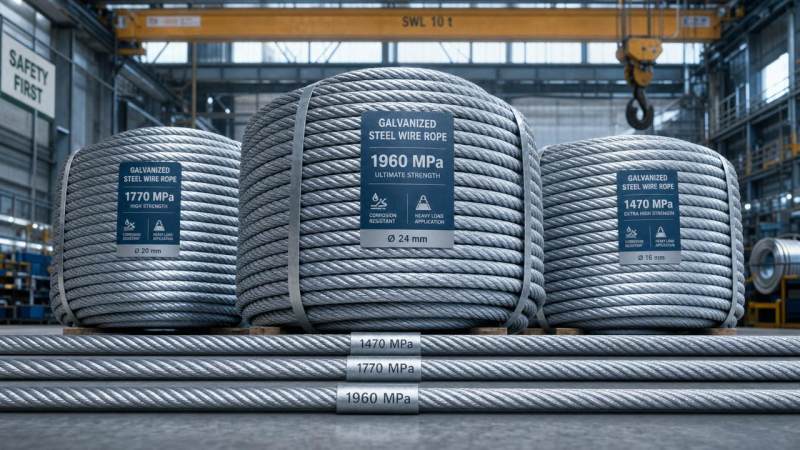
In steel-intensive projects, tensile grade is not just a catalog number. It affects working load, fatigue behavior, sheave compatibility, safety margin, and replacement planning. When buyers compare Galvanized Steel Wire Rope 1470Mpa to 1960Mpa options, they are really balancing mechanical performance against service environment and total project risk.
A 1470Mpa grade wire rope often supports general lifting, structural bracing, and applications where flexibility and cost discipline matter. Higher grades such as 1770Mpa, 1870Mpa, and 1960Mpa are commonly selected when the project needs stronger load-bearing capacity under limited rope diameter, especially in cranes, hoisting systems, suspended structures, and industrial handling lines.
For project managers, the practical question is simple: do you need a larger diameter rope with lower tensile grade, or a smaller diameter rope with higher tensile strength? The answer depends on equipment design, safety factors, corrosion exposure, and procurement timing.
- Lower grades may reduce procurement cost and improve bend performance in some systems.
- Higher grades may help reduce rope diameter while maintaining required breaking force.
- Galvanized surfaces improve corrosion resistance for outdoor, marine-adjacent, and long-cycle infrastructure use.
Why galvanizing matters as much as strength
Many failures in wire rope projects are not caused by insufficient nominal strength. They come from corrosion, poor lubrication retention, surface damage, or mismatch between rope design and operating environment. That is why Galvanized Steel Wire Rope 1470Mpa to 1960Mpa remains a preferred choice for exposed construction sites, transportation systems, utilities, and industrial facilities.
A galvanized coating helps protect the steel substrate against moisture, chemical mist, and intermittent weather exposure. In project terms, this can support longer service intervals, more stable inspection results, and fewer unplanned replacements, especially where shutdown costs are high.
Which grade is better for your application and budget?
The table below gives a practical selection view for Galvanized Steel Wire Rope 1470Mpa to 1960Mpa in common engineering scenarios. It is intended to support early-stage procurement alignment between engineering, sourcing, and site teams.
This comparison shows that higher strength is not automatically the better commercial choice. If the system does not need diameter reduction or high breaking force, a mid-range option may deliver lower overall cost with easier replacement planning.
Application-driven selection logic
Project leaders usually make better decisions when selection starts from the jobsite, not from the price sheet. Consider the following decision sequence before confirming your Galvanized Steel Wire Rope 1470Mpa to 1960Mpa order.
- Define the actual load condition, including static load, dynamic load, shock load, and lifting frequency.
- Check whether corrosion resistance is critical due to rain, humidity, marine atmosphere, or chemical exposure.
- Review installation equipment, including drum diameter, sheave condition, anchoring method, and allowable rope construction.
- Confirm standards and documentation needed by the client, consultant, or local authority.
- Align delivery schedule with the project milestone to avoid site idle time and emergency air shipment.
What technical details should project managers verify before purchase?
Strength grade alone cannot define whether a rope is suitable. For Galvanized Steel Wire Rope 1470Mpa to 1960Mpa, technical review should cover rope construction, nominal diameter, zinc coating condition, lay direction, core type, lubrication, and dimensional tolerance. These points directly affect field performance.
In many steel and infrastructure projects, wire rope also works alongside galvanized steel components such as towers, support frames, road protection systems, utility poles, and structural accessories. Where corrosion consistency matters across a project package, sourcing teams often coordinate related steel products from one supply network to simplify documentation and finish matching.
For example, buyers handling electric power towers, communication towers, highway protection systems, street light poles, marine components, and building steel structure parts may also review Galvanized Round Steel for connected fabrication needs. This is especially useful when the project requires anti-corrosion steel inputs, customized length, and compliance with common standards such as ASTM, EN, JIS, and GB.
Key parameters that affect field performance
The following table summarizes the technical checkpoints that should be confirmed before issuing a purchase order. This helps reduce disputes between design assumptions and delivered material.
This technical review is where experienced suppliers add value. A manufacturer with structured quality control can help check specification gaps before production starts, reducing the risk of receiving material that meets paperwork but not actual installation needs.
How to reduce sourcing risk in global steel and wire rope procurement
For international buyers, the biggest issue is rarely just unit price. It is whether the delivered material matches project standards, arrives on time, and remains consistent across batches. This is especially important for Galvanized Steel Wire Rope 1470Mpa to 1960Mpa, where performance differences can affect safety-critical operations.
Hongteng Fengda supports global construction, industrial, and manufacturing projects as a structural steel manufacturer and exporter from China. The company supplies angle steel, channel steel, steel beams, cold formed steel profiles, and customized structural steel components, while working under strict quality control and internationally recognized standards including ASTM, EN, JIS, and GB.
For project managers, this matters because wire rope selection is often connected to wider steel package decisions. If the supplier understands structural steel fabrication, anti-corrosion requirements, dimensional control, and export documentation, communication becomes faster and technical alignment becomes easier.
Risk points that should be checked before order confirmation
- Specification mismatch between design documents and purchasing descriptions.
- Incomplete quality documents, especially when third-party inspection or project filing is required.
- Unclear lead time for production, galvanizing, testing, packaging, and export shipment.
- Damage risk during transport if rope coils or related steel components are packed without adequate protection.
- Overlooking companion materials needed for integrated installation packages, including related galvanized steel items.
Cost control: when should you choose higher strength and when should you not?
A common purchasing mistake is assuming that stronger material always lowers total cost. In reality, Galvanized Steel Wire Rope 1470Mpa to 1960Mpa must be evaluated against full project economics: equipment compatibility, service life, maintenance frequency, and replacement complexity.
Higher tensile grades can be commercially attractive when they allow a smaller rope diameter, reduced self-weight, or improved design efficiency. However, if your system is already sized for a standard diameter and moderate load range, upgrading strength may add cost without meaningful site benefit.
The best cost decision usually comes from lifecycle thinking rather than ex-works price alone. Outdoor projects with long operating cycles may justify galvanized, higher-performance options because shutdowns, labor, and replacement logistics cost more than the initial difference in material price.
Simple cost decision framework
This approach helps teams avoid over-specification and under-specification at the same time. Both can be expensive, and both are common in rushed procurement cycles.
FAQ: what do buyers often ask about Galvanized Steel Wire Rope 1470Mpa to 1960Mpa?
How do I choose between 1470Mpa and 1960Mpa?
Start with design load, safety factor, rope diameter limits, and equipment condition. If the system has enough space and moderate duty, 1470Mpa to 1770Mpa may be practical. If the project needs high breaking force in a compact envelope, 1870Mpa to 1960Mpa may be justified after engineering confirmation.
Is galvanized wire rope always better than non-galvanized rope?
Not always, but it is often better for exposed environments. Galvanized Steel Wire Rope 1470Mpa to 1960Mpa is especially valuable where moisture, weather variation, or long storage periods can accelerate corrosion. For indoor, controlled environments, the cost-benefit should be assessed case by case.
What standards or documents should I request from the supplier?
Ask for the agreed specification, mechanical property confirmation, dimensional inspection data, and any project-required material documentation. If the overall steel package must align with ASTM, EN, JIS, or GB, confirm this before production rather than after shipment booking.
Can one supplier support both structural steel and related galvanized components?
Yes, and that often improves efficiency. Buyers managing towers, frames, support structures, and accessory steel may benefit from coordinated sourcing. Along with wire rope needs, related products such as Galvanized Round Steel can support fabrication, fastening, machining, and anti-corrosion consistency across the project.
Why choose a structured steel export partner for your next inquiry
When your project involves steel structures, galvanized accessories, and performance-sensitive materials, supplier coordination becomes a major cost factor. Hongteng Fengda helps reduce sourcing complexity by supporting standard and customized structural steel requirements for global buyers across North America, Europe, the Middle East, and Southeast Asia.
If you are evaluating Galvanized Steel Wire Rope 1470Mpa to 1960Mpa for construction, lifting, infrastructure, or industrial use, the most useful next step is a technical-commercial review. You can discuss required tensile grade, application environment, quantity planning, related steel components, lead time, inspection needs, and export packing expectations before placing an order.
- Confirm parameters such as tensile grade, diameter, and corrosion exposure.
- Check whether standard specifications or OEM customization better fit your project.
- Review delivery schedule based on your site milestone and shipment route.
- Align quality documents and applicable standards before production starts.
- Request quotation support, sample discussion, and integrated steel supply planning if your project includes multiple product categories.
For project managers and engineering leaders, good selection is not about buying the strongest rope on paper. It is about choosing the right specification, with the right protection, from a supplier that can deliver consistent steel products on schedule. That is the simplest path to safer execution and better cost control.
Please give us a message


Please enter what you want to find