Carbon steel square tubing is strong enough for a trailer only when the selected section matches the real load path, the actual span between supports, the connection details, and the service conditions. A tube that looks heavy in a quotation sheet can still be undersized in bending, too flexible in torsion, or vulnerable at weld zones if the frame design concentrates stress around spring hangers, tongue joints, axle mounts, or crossmember intersections. For trailer work, the question is rarely whether carbon steel square tubing for trailer fabrication is strong in a general sense. The useful question is whether a specific outer size, wall thickness, steel grade, and fabrication method can carry repeated transport loads without excessive deflection, local buckling, weld cracking, or distortion.
Start with the load case instead of the catalog. Trailer frames do not experience only static vertical weight. They see dynamic input from potholes, braking, cornering, uneven loading, vibration, and twisting when one wheel climbs higher than the other. If the tubing is chosen only by nominal capacity under a simple static assumption, the evaluation will often miss the part of the frame that fails first. In many layouts, the highest stress does not occur at mid-span of the main rail. It can appear near the tongue transition, at a short unsupported zone beside a welded bracket, or in a heat-affected area where section continuity has been interrupted.
Read the tube specification as a structural section, not as a commodity size
The first pass is to verify four basic items together: outside dimension, wall thickness, material grade, and manufacturing standard. Square tubing with the same outer dimension can behave very differently if one section has a thin wall and another has a heavier wall. The outside size affects section modulus and stiffness, while wall thickness strongly influences local buckling resistance, weld robustness, and tolerance to impact damage. Material grade matters because yield strength sets the threshold before permanent deformation begins, but a higher grade alone does not correct a weak geometry. A small high-strength tube may still underperform a larger moderate-strength tube if bending stiffness controls the design.
Standards such as ASTM, EN, JIS, or GB should be treated as part of the strength review, not just procurement paperwork. They define chemical composition ranges, mechanical property requirements, tolerances, and sometimes the forming route. For trailer fabrication, those details affect weldability, dimensional consistency, and confidence that the supplied tube actually matches the declared strength level. Mill test reports, heat numbers, and inspection records become relevant when the tubing is expected to support a safety-critical frame rather than decorative or lightly loaded structure.
Where trailer strength is usually decided
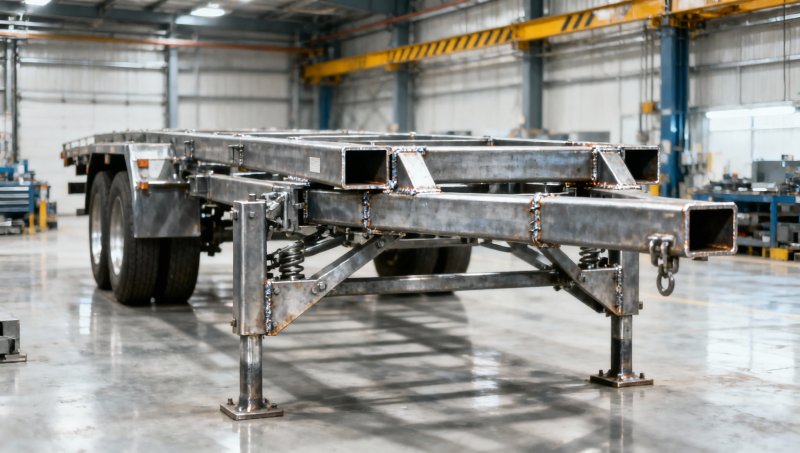
Main rails carry the largest bending action, but crossmembers, outriggers, and tongue members often control whether the frame remains stable in service. A square tube that is adequate as a straight rail may be inadequate where attachments introduce eccentric loading. If the axle group is mounted below the frame, loads may be transferred through brackets that create concentrated stress on the tube wall. If suspension hardware is attached directly to thin-wall tubing, the wall can ovalize or tear around the weld before the full member strength is ever reached.
Deflection deserves as much attention as ultimate strength. A trailer frame can remain below yield stress yet still be unacceptable if it sags enough to affect axle alignment, deck flatness, door fit, or coupling behavior. Excessive flexibility can also increase fatigue risk because repeated movement amplifies stress cycles at weld toes and connection edges. In practice, a section that passes a simple strength calculation may still need to be increased because service stiffness is poor.
Section size, wall thickness, and why thin walls are often overestimated
Many evaluation errors come from focusing on outer dimensions while underestimating the effect of wall thickness. For square hollow sections, a reduction in wall thickness does more than lower weight. It reduces the section's ability to resist local denting, bracket weld pull-through, and heat input during fabrication. Thin-wall tube may also distort more easily during cutting and welding, leaving residual stress or twist in long rails. For a trailer, that matters because alignment errors travel through the entire assembly. Once coupler, axle, and deck geometry are no longer square, road behavior and tire wear can change even if the frame has not visibly failed.
Another common mistake is assuming that any closed section automatically solves torsion. Square tubing does provide better torsional behavior than many open sections, but torsional demand depends on frame layout. A single tube tongue welded into a narrow front connection may see a severe combination of bending and torsion during turning or uneven ground contact. If gusseting, fish plates, or reinforcement sleeves are absent, the joint can become the weak location. In these cases, strength is governed by local geometry and weld design rather than by the nominal tube section alone.
Material grade is important, but geometry usually controls first
Carbon steel tubing for trailers is often evaluated by grade labels such as Q235, Q345, S235JR, SS400, or similar equivalents under different standards. These designations are useful, but they should not be treated as directly interchangeable without reviewing the relevant specification. Yield strength, tensile range, impact requirements if any, and chemical composition limits can differ. Welding behavior may also vary slightly depending on carbon equivalent and thickness. If cold-formed tubing is used, the manufacturing process may alter corner properties and residual stresses, which can influence how the section performs near highly stressed welded details.
Even when a higher-strength grade is available, increasing grade without changing geometry may offer limited benefit if deflection governs, if bolt bearing on the wall is the critical mode, or if the design is fatigue-sensitive. A larger section with moderate yield strength often provides a better margin for trailer frames than a smaller high-strength tube pushed close to its limits.
Mid-frame reinforcement can change the selection logic
In some trailer layouts, the main square tubing works together with angle components used as brackets, crossmember seats, localized stiffeners, or reinforcement around attachment points. That is where section compatibility matters. For example, when selecting complementary bracing or framing elements, dimensions and grade ranges similar to those found in Angle Steel Supplier specifications, including thickness from 3-20mm and common grades such as Q235, Q345, SS400, ST37-2, ST52, or S235JR, may be relevant if the reinforcement is expected to share load with the tube. The point is not to mix parts arbitrarily, but to make sure local reinforcement has enough stiffness and weldable thickness to transfer force without shifting failure into the tube wall beside it.
Weld quality can reduce practical strength long before the steel grade is reached
A sound tube specification can still fail in fabrication. Trailer frames concentrate numerous fillet welds in short distances, often around suspension points and coupler zones. Poor fit-up, undercut, excessive gap, lack of fusion, and abrupt weld termination can all reduce fatigue life. Overwelding creates its own problems by adding heat, increasing distortion, and introducing larger residual stress than necessary. If the design uses intermittent welds, the spacing should match the real load transfer mechanism rather than be copied from unrelated structural details.
Holes, cope cuts, and end notches also need attention. Every opening in square tubing interrupts the load path and can reduce local capacity more than expected, especially when the opening is close to a support or a welded bracket. A tube that appears adequate in its uncut form may no longer be adequate after drainage holes, mounting penetrations, or access cuts are introduced. When drawings are reviewed, the final fabricated shape matters more than the nominal stock section.
How to assess whether the chosen section is actually enough
A useful review sequence is to define the gross trailer load condition, distribute it to the frame according to the real support arrangement, and then study the frame in terms of bending, shear, torsion, local attachment stress, and deflection. Short trailers with closely spaced crossmembers may be governed by local bracket zones. Longer trailers are more likely to be controlled by rail stiffness and tongue transition details. If the deck carries concentrated equipment loads instead of a uniform load, the evaluation should reflect that directly rather than smearing the load across the full platform.
- Compare the actual unsupported length of the main rails with the tube section modulus, not just the full trailer length shown on the drawing.
- Review whether the wall thickness can accept welds, bolt bearing, and bracket loads without crushing or tearing at the connection.
- Look for places where impact loading may be much higher than the nominal payload suggests, especially near ramps, axle seats, and tongue joints.
- Confirm the declared standard and grade on material documents so the tubing in the shop matches the section used in calculations.
If finite element analysis is used, it should include realistic supports and connection stiffness. If hand calculation is used, assumptions need to stay conservative around concentrated load zones. Either approach becomes weak if the actual trailer geometry later changes in production through different crossmember spacing, added cutouts, or substituted wall thickness.
Service environment can shift the answer
Strength in a dry, controlled application is different from strength in corrosive or abrasive service. Carbon steel square tubing for trailer use may lose effective wall thickness over time if drainage is poor, road salts collect inside closed sections, or coating damage remains at welded joints and drilled holes. A member that is structurally acceptable on day one may become marginal later if corrosion allowance was never considered. Closed sections should therefore be reviewed for venting, drainage, coating access, and end sealing detail, because hidden internal corrosion can go unnoticed until cracking or local perforation appears.
Transport and handling before assembly can also matter. Long tubes with inadequate support during shipping or yard storage may arrive with sweep, twist, or denting. Those defects may be within appearance tolerance yet still complicate frame alignment. If a section needs straightening after delivery, residual stress and local damage should be considered before assuming the tube still behaves like untouched stock.
Signals that the selected tube may be undersized
Certain signs in drawings or prototypes usually indicate that the current section is close to the limit: large spans with few crossmembers, suspension brackets welded directly onto relatively thin wall tubing, visible frame springiness when jacked at one corner, localized buckling near coupler or hanger welds, and frequent reliance on patch plates to correct deformation discovered late in fabrication. Another warning sign is when the design requires many local stiffeners just to make a light tube workable. At that point, a larger primary section is often cleaner and structurally more reliable than repeatedly repairing weak spots with extra pieces.
On the other hand, oversizing without discipline has costs. Heavier tubing increases tare weight, can alter axle balance, and may complicate weld sequencing. The objective is not simply to choose the thickest square tube available. It is to select a section with enough reserve for the real load spectrum, tolerable deflection, practical fabrication, and maintainable corrosion protection.
A final decision should rest on the fabricated frame detail, not on the tube name alone. When the tubing size, wall, grade, weld design, and attachment geometry all work together under the expected transport conditions, the section is likely strong enough. If any one of those items remains uncertain, the specification is still incomplete, even when the tube itself appears substantial on paper.


