Yes. A steel sheet that does not match the part layout, machine envelope, or handling route can lengthen fabrication far beyond the time spent making the first cut. The delay is rarely caused by one dramatic failure. It accumulates through extra trimming, poor nesting, repeated loading, additional weld seams, part identification problems, and rework when dimensional control is lost.
The “right” steel sheet size is not simply the largest sheet available or the size with the lowest price per tonne. It is the size that allows the required parts to be cut, moved, formed, and assembled with the fewest avoidable operations while preserving material traceability and drawing tolerances. A sheet that appears economical at receiving can become expensive in the workshop if it forces operators to create unnecessary intermediate pieces.
Where the extra fabrication time comes from
Steel fabrication is a linked process. A sizing decision made before cutting affects material preparation, CNC programming, loading, cutting, forming, fit-up, welding, inspection, and dispatch. The problem becomes visible when the stock sheet does not correspond to the geometry and quantity of the parts required.
Consider a long gusset, stiffener, cover plate, or bracket that is only slightly longer than the usable width of the incoming sheet. If it cannot be rotated and nested within the available area, the operator may need to cut a strip first, reposition it, and then make the final profile cut. That adds handling and introduces another opportunity for the strip to shift or lose its reference edge. If the component cannot be produced as one piece, the alternative may be a welded joint, which brings fit-up, welding, cooling, dressing, and inspection into a part that was originally intended to be cut from a single sheet.
Small sheets can create the same issue in a different form. They may fit the machine easily, but they require more frequent loading and unloading. More sheets also mean more identification marks, more heat numbers or batch references to control, and more remnants to sort. On a job with many repeated parts, these short interruptions can consume more time than the cutting cycle itself.
Oversized sheets are not automatically better. If a sheet exceeds the practical lifting capacity, suction-lifter capacity, roller table length, or machine bed size, it must be split before normal processing. That preliminary cut may leave non-square edges, reduce nesting options, and create awkward remnants. Large sheets can also be slow to align accurately when the material is bowed, warped, or has damaged corners from transport and storage.
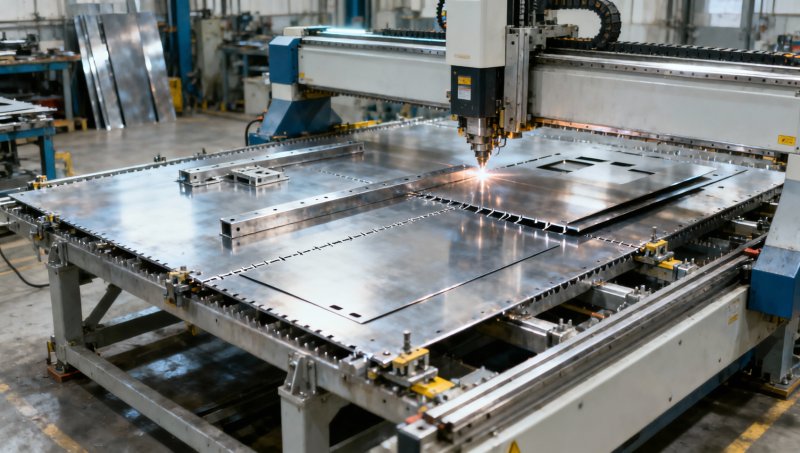
Nesting efficiency is a production issue, not only a material-yield issue
Nesting software can arrange parts efficiently only within the usable cutting area. The usable area is smaller than the nominal steel sheet size because operators need to account for edge damage, out-of-square sides, clamp zones, lead-ins and lead-outs, torch clearance, and the need to retain small parts safely during cutting.
A poor match between part dimensions and sheet dimensions creates narrow strips, isolated corners, and remnants that cannot be used on later work. Material waste is the visible result, but the operational impact is often more immediate:
- More time is spent deciding whether a remnant is usable.
- Operators may need to interrupt a programmed nest to prevent small parts from tipping or moving.
- Extra skeleton handling is needed after plasma, laser, oxy-fuel, or waterjet cutting.
- Part marks can be lost when pieces are too small or too closely spaced.
- Additional stock sheets may be opened before the scheduled batch is complete.
The best nesting result on screen is not always the best result on the shop floor. A layout that pushes every part tightly together may improve theoretical yield but create difficult part release, excessive localized heat, or a large number of small pieces that are hard to separate and identify. Practical nesting needs enough bridge tabs, separation space, and safe removal access for the cutting process being used.
For this reason, sheet size should be reviewed alongside the actual nest, not only against an overall bill of materials. A project may contain enough total square metres of steel, yet still require excessive cutting time because the individual component shapes do not fit efficiently into the selected format.
Machine capacity sets a hard limit
Every cutting machine has a nominal bed size, but the effective operating limit may be narrower. Clamps, gantry travel, loading equipment, fume extraction arrangements, and the need to keep a stable reference edge can reduce the practical cutting area. A steel sheet size selected without checking these constraints can cause avoidable manual intervention.
For CNC plasma or oxy-fuel cutting, an oversized sheet may have to be indexed: one section is cut, then the sheet is moved for the next section. Indexing takes time and can introduce positional error if the new datum is not established carefully. If the sheet is heavy, movement may require an overhead crane rather than a quick manual adjustment. The cut schedule then depends on crane availability as well as machine availability.
Laser cutting can be even more sensitive to sheet flatness and secure positioning. A sheet with excessive bow, twist, or edge damage may not sit consistently on the table. The resulting risk is not merely an imperfect cut; height-control problems, collisions, incomplete cuts, or damage to consumables can stop the cycle. The nominal length and width may be correct, but a poorly handled sheet can still be unsuitable for efficient automated processing.
Press brakes and folding equipment create another size constraint. A blank may fit the cutting table but be too large to turn safely during bending. Long, wide, or thin blanks can flex under their own weight, making it difficult to maintain the intended bend line. Extra operators, support arms, or staged bending may be required. In that situation, the wrong sheet size has shifted work from an automated operation to a handling-intensive one.
Incorrect starting size can affect dimensional control
Fabrication drawings define finished dimensions, hole locations, edge distances, and assembly interfaces. The stock sheet must provide enough material around the cut profile to achieve these requirements after trimming, cutting, and any subsequent forming. When the selected sheet is too close to the finished dimensions, there is little margin for squaring, removing damaged edges, or correcting a misaligned first cut.
This is particularly important when the incoming sheet has mill-edge irregularities, transport damage, corrosion at the edge, or a slight lack of squareness. If a drawing calls for a rectangular plate with critical hole positions, operators may need to establish a reliable datum by trimming one or two edges. A sheet ordered exactly to the finished blank size can therefore be too small in practice.
Thermal cutting adds another variable. The heat-affected zone, kerf width, and heat input must be considered in the cutting program. Thin sheet can distort if long cuts are made in an unsuitable sequence. Thick material may require substantial lead-ins and lead-outs or additional pierce locations. Where dimensions are tight, there must be sufficient material for final edge preparation or machining if the process plan requires it.
Trying to recover a part from an undersized blank often leads to improvised decisions: shifting hole patterns, reducing edge margins, adding a welded extension, or accepting a profile that requires later correction. These choices consume time and can create nonconforming work. A delay is not always obvious at the cutting station; it may emerge when the part reaches fit-up and does not align with adjoining steelwork.
Additional joints are usually slower than selecting a usable format
When a required component is larger than the available steel sheet size, fabricators may divide it into sections and weld them together. That can be a valid engineered solution when permitted by the design and welding requirements. It should not be treated as a routine substitute for obtaining an appropriate sheet or plate format.
An added joint changes the work content. The pieces need accurate edge preparation, alignment, tack welding, welding in a controlled sequence, cleaning, and dimensional checking. Depending on the joint and project requirements, it may also require visual examination or other specified inspection. Welding heat can introduce distortion, especially in thinner sheet or asymmetric assemblies, and straightening adds another operation.
There is also a sequencing effect. A one-piece plate can move directly from cutting to drilling, bending, or assembly. A built-up plate may wait for welding capacity, cooling time, inspection release, and correction work before it can continue. If that part is on the critical path, the initial sheet-size mismatch can delay several downstream operations.
The appropriate question is not whether a welded extension is technically possible. It is whether the drawing, welding procedure, quality requirements, and production schedule allow it without creating a greater risk than sourcing the correct material format.
Handling time is often underestimated
Material movement is easy to overlook because it is distributed across the shift. Yet an unsuitable sheet size can create repeated handling: moving a sheet from storage to a cutting table, rotating it, removing it for a preliminary trim, returning remnants to storage, and bringing it back later for a small part.
Large sheets require suitable lifting points, adequate crane clearance, and a stable method of support. Thin sheets can sag and develop sharp movement when lifted improperly. Smaller offcuts may be difficult to lift safely without magnets, clamps, or purpose-built handling tools. Time spent making a safe lift is necessary time; time spent making extra lifts because the material format was poorly selected is avoidable time.
Remnant management matters here. A remnant is useful only when its grade, thickness, dimensions, and traceability remain clear. If remnants are mixed, unmarked, or stored without a reliable record, operators cannot safely assume they are suitable for a later part. The material may then be set aside or scrapped even though its physical dimensions appear adequate. Selecting stock formats that create manageable, repeatable remnants reduces this uncertainty.
Thickness, flatness, and tolerances belong in the same decision
“Steel sheet size” is commonly understood as length and width, but fabrication performance also depends on thickness, flatness, and dimensional tolerance. A sheet that is nominally the right plan size may still slow production if it does not behave predictably through the required process.
Thickness affects cutting speed, pierce time, edge quality, and the capacity needed for bending or punching. It also affects how much a large blank can deflect during handling. Flatness affects cutting accuracy, drilling setup, and bend consistency. A sheet with visible waves or residual stress may move after parts are cut free, particularly when long narrow shapes are released from the nest.
Operators should distinguish between a problem created by the supplied size and a problem caused by material condition. Both can interrupt production, but the corrective action is different. Reprogramming a nest may help a format issue; it will not correct excessive distortion, wrong thickness, or material that does not meet the drawing specification.
A practical check before cutting begins
Before committing a batch to the cutting table, compare the actual received sheet against the production requirement rather than relying only on the purchase description. The check should establish whether the sheet can be processed as planned with usable margins and safe handling.
- Confirm actual length, width, thickness, grade, and identification against the job documentation.
- Check whether the sheet fits the available cutting bed and loading method without indexing or preliminary splitting.
- Review the nest for trim allowances, clamp areas, lead-ins, cut spacing, and secure retention of small parts.
- Identify whether critical parts need a clean reference edge or extra stock for machining, beveling, or edge preparation.
- Check whether the largest blanks can be turned, bent, drilled, and moved through later operations.
- Decide how usable remnants will be marked, measured, and stored before the skeleton is removed.
This review does not need to become a lengthy planning exercise for every sheet. Its value is in catching the situations that force unplanned work: a part that barely does not fit, a blank that cannot be bent safely, a nest that leaves unusable strips, or a material format that requires an unapproved welded joint.
The useful definition of “wrong size”
A steel sheet is the wrong size when it creates extra process steps that were not part of the intended fabrication route. It may be too small for a one-piece component, too large for the machine or handling equipment, too narrow for efficient nesting, or too close to finished dimensions to allow proper trimming and tolerance control.
The result is not limited to higher scrap. It can mean slower loading, more programming changes, poorer part identification, extra welds, greater distortion risk, and delayed assembly. Matching steel sheet size to the drawing, nesting plan, equipment limits, and downstream operations protects the flow of work. In fabrication, the fastest cut is not always the one with the shortest machine cycle; it is the one that allows the part to move to the next operation without correction, compromise, or unnecessary handling.
Please give us a message


Please enter what you want to find