For projects exposed to salt spray, humidity, and harsh weather, galvanized steel for construction offers lasting corrosion resistance and lower lifecycle costs. From coastal buildings to infrastructure, buyers often compare galvanized steel price, steel plate for construction, and steel rebar for construction to balance durability, compliance, and budget. This guide explains what matters most when selecting reliable structural steel solutions.
In coastal construction, material selection affects not only initial procurement cost but also maintenance frequency, service life, and safety performance over 10, 20, or even 30 years. Chloride-rich air, high annual humidity, and repeated wet-dry cycles can accelerate corrosion in unprotected carbon steel, especially in load-bearing frames, purlins, roof members, and exposed secondary structures.
For engineers, purchasing teams, distributors, and project owners, the key question is rarely whether corrosion protection is needed. The real question is which galvanized structural steel solution fits the environment, the load requirement, the fabrication method, and the budget target. That includes coating type, base steel grade, dimensional tolerance, fabrication compatibility, and supplier reliability.
As a structural steel manufacturer and exporter from China, Hongteng Fengda supplies angle steel, channel steel, steel beams, cold formed steel profiles, and customized structural steel components for global projects. With production aligned to ASTM, EN, JIS, and GB standards, the company supports buyers who need consistent quality, dependable lead times, and practical sourcing support for coastal buildings, industrial facilities, warehouses, and infrastructure works.
Why Galvanized Steel Performs Better in Coastal Construction
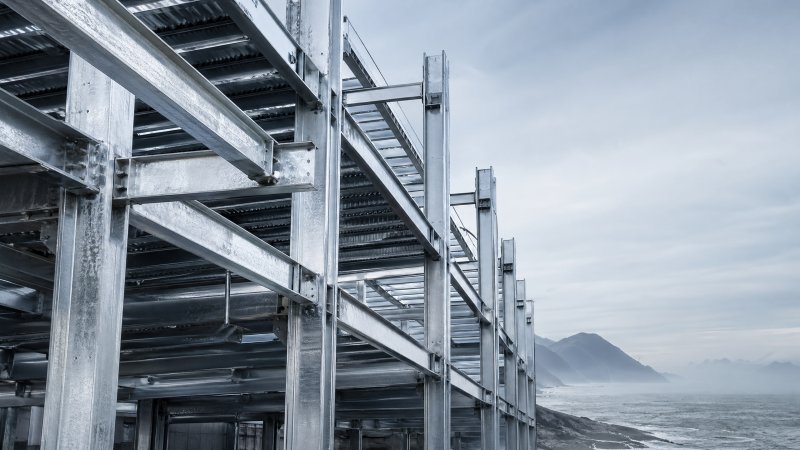
Coastal environments combine 3 major corrosion drivers: salt deposition, moisture retention, and temperature fluctuation. In many shoreline zones, airborne chlorides settle on steel surfaces daily, and when relative humidity rises above common condensation thresholds, corrosion starts faster than in inland locations. This is why galvanized steel for construction is widely selected for roof framing, wall members, walkways, support brackets, and exposed steel accessories.
The zinc coating acts as a protective barrier and also provides sacrificial protection. If the surface is scratched during transport or installation, surrounding zinc can still help shield the underlying steel. In practical terms, this reduces the risk of early rust staining at cut edges, bolt zones, and handling points, though proper detailing and touch-up procedures are still important for aggressive marine exposure.
For project finance and asset management teams, lifecycle economics matter as much as material science. A galvanized section may cost more upfront than untreated steel, but reduced repainting cycles, less downtime, and lower replacement risk often improve the total cost picture over 15–25 years. In facilities that are difficult to shut down, maintenance savings can be more significant than the original material premium.
Performance also depends on design details. Drainage, ventilation, water traps, contact with dissimilar metals, and the distance from direct surf exposure all influence actual durability. For this reason, technical evaluation should always combine the steel grade, coating method, structural role, and site condition instead of relying on price comparison alone.
Typical coastal risk factors to assess
- Distance from shoreline, such as under 1 km, 1–5 km, or over 5 km, because chloride intensity usually changes by zone.
- Exposure condition, including open-air framing, sheltered internal members, roof edge positions, and splash-prone service areas.
- Maintenance access frequency, especially for members located 8–20 meters above grade or above operating lines.
- Joining and fabrication method, such as bolting, perforation, field cutting, and welded assemblies requiring local coating repair.
Comparison of common steel choices in coastal projects
The table below compares how galvanized structural steel is typically evaluated against other common construction steel options in marine or near-marine applications.
The key conclusion is that galvanized steel often offers the most balanced solution for coastal construction where corrosion resistance, structural performance, and procurement control must be managed together. It is especially practical for medium- to large-scale projects requiring repeatable section sizes and stable supply.
How to Select the Right Galvanized Structural Steel for Marine Exposure
Selecting galvanized steel for construction should begin with the member function. A primary beam, a roof purlin, a wall beam, and a bracket face different load paths, fixing conditions, and exposure patterns. Base steel grades such as Q235B, Q345B, S275, S355, A36, or A572 should be chosen according to design strength, fabrication needs, and the governing standard used by the project.
Thickness and dimensional tolerance also matter. In many structural applications, thin-gauge sections improve weight efficiency but may require tighter control during transport, perforation, and installation. For fabricated profiles used in roofing or wall systems, buyers often ask for length options from 2 to 12 meters and tolerance around ±1% to simplify site assembly and reduce rework time.
Another important factor is whether the product is standard, customized, or OEM. Standard sections can speed up delivery, but customized punching patterns, edge conditions, and lengths can reduce field labor significantly. On projects with hundreds of repetitive members, pre-engineered fabrication may save several installation steps and improve alignment consistency across multiple buildings.
Procurement teams should also confirm document readiness before ordering. For export projects, technical files may include mill test data, dimensional inspection records, packing lists, coating information, and compliance references to CE, SGS, BV, or ISO-related quality systems where applicable. These records help quality control staff and project managers coordinate inbound inspection with fewer delays.
A practical specification checklist
- Define the exposure level: open coast, industrial coast, port area, or sheltered inland-facing side.
- Match structural demand to base steel grade, such as Q345B or S355 for higher strength requirements.
- Confirm coating route and whether post-fabrication galvanizing or pre-galvanized supply better fits the project.
- Review lengths, hole positions, edge type, and tolerance before mass production starts.
- Check shipping method, bundle protection, and lead time, often ranging from 2–6 weeks depending on quantity and customization.
Decision factors by project role
Different stakeholders look at the same steel package through different priorities. The comparison below helps align engineering, procurement, and commercial requirements before purchase approval.
When teams align these decision points early, approval cycles are usually faster and change orders are reduced. That is particularly valuable on export projects where rework can add several weeks and additional logistics cost.
Product Integration: Galvanized Profiles for Roof and Wall Systems
In many coastal projects, corrosion protection is not limited to main columns and beams. Secondary framing members such as purlins, wall beams, and lightweight roof supports often face direct condensation and airborne salt exposure. These members are numerous, repetitive, and critical to installation speed, which makes galvanized formed sections a highly practical choice.
A good example is the Z-beam, a Z-shaped steel profile widely used in steel structure construction purlin systems, wall beams, brackets, mechanical columns, and light manufacturing beams. For projects that need optimized dead load and efficient fastening, this kind of profile supports modular installation while maintaining stable section performance.
Available material options can include Q235B, Q345B, Q420C, Q460C, SS400, SS540, S235, S275, S355, A36, A572, G50, and G61. Typical technical parameters include thickness from 6–25 mm, length from 2–12 m or customized, edge options such as mill edge and slit edge, and dimensional tolerance around ±1%. Perforated and galvanized coated versions can help reduce on-site drilling and shorten installation time.
For contractors working on workshops, warehouses, industrial sheds, and coastal support buildings, these profiles can be combined into lightweight roof systems, brackets, or other secondary construction assemblies. Their zinc or silver appearance also helps with visual inspection during receiving and erection, especially when dozens or hundreds of bundles arrive in sequence.
When this profile is a suitable choice
- When the project needs repetitive roof or wall members with predictable spans and fast bolted installation.
- When customized lengths between 2 and 12 meters can reduce cutting loss and improve site productivity.
- When corrosion resistance is required but section weight must remain lower than many conventional hot-rolled members.
- When buyers want multiple grade options to align structural design with regional standards and project budgets.
Points to confirm before ordering formed galvanized members
Confirm span, hole layout, connection method, and roof or wall loading before finalizing the section. It is also wise to review whether perforation is done in the factory, whether nesting or bundle marking is required, and whether the shipment must match phased installation. These details often influence both production sequencing and total installed cost more than the unit price alone.
Quality Control, Standards, and Delivery Planning for Export Projects
For galvanized steel in coastal construction, quality consistency depends on more than material grade. Export buyers should review 4 core areas: raw material traceability, dimensional accuracy, coating condition after fabrication, and packing suitability for sea transport. A section that leaves the mill in good condition can still be damaged if bundle protection, edge support, or moisture control during shipping is inadequate.
Manufacturers serving international projects are commonly asked to align with ASTM, EN, JIS, or GB specifications depending on destination and engineering documents. This matters because section designation, mechanical property requirements, and inspection language may differ. Early document alignment can prevent disputes during pre-shipment review or on-site receiving inspection.
Lead time planning is another key factor. Standard galvanized sections may move faster, while custom fabricated structural components often require additional drawing confirmation, punching setup, sampling, and batch inspection. In practical export operations, total timing may include 7–15 days for production of simpler items or 3–6 weeks for larger and more customized orders, excluding sea transit.
Hongteng Fengda supports global buyers with stable production capacity, quality control, and customized structural steel supply. For importers, distributors, and engineering contractors, supplier responsiveness during specification clarification can be just as important as the product itself, especially when one missing detail can delay customs clearance or site installation.
Recommended export quality checkpoints
The following checklist is useful for purchase orders involving coastal structural steel, especially where multiple part types and shipment batches are involved.
A disciplined QC and logistics process helps buyers control sourcing risk, especially when delivery sequences affect crane planning, subcontractor scheduling, and payment approval milestones. In marine projects, good steel can still underperform if shipping and storage are not managed properly.
Common Mistakes, Maintenance Planning, and Buying Advice
One common mistake is focusing only on galvanized steel price without considering the full environment and installation method. A lower-cost section may become more expensive if it requires extra coating repair, more site drilling, or earlier replacement. In coastal construction, procurement should compare at least 5 factors together: material grade, coating solution, fabrication scope, lead time, and expected maintenance interval.
Another mistake is treating all galvanized products as equal. The structural function, exposure category, and fabrication stage matter. Roof edge members, open service platforms, and sea-facing wall girts may need more careful detailing than interior members in partially enclosed buildings. It is often worth reviewing the most exposed 10%–20% of steel members separately rather than applying one assumption to the entire package.
Maintenance planning should also start before installation. Even galvanized steel benefits from routine inspection for coating damage, standing water, debris buildup, and contact corrosion around incompatible fixings. A practical inspection cycle can be every 6–12 months in harsh coastal sites, with additional checks after storms or shutdown maintenance windows.
For buyers comparing steel plate for construction, steel rebar for construction, and galvanized structural profiles, the right answer depends on the structural role. Rebar is embedded in concrete, plate is used for fabrication and connection assemblies, while galvanized sections serve visible framing and support members that need long-term atmospheric protection. Matching the product to the duty is the best way to avoid overpaying or under-specifying.
FAQ: What buyers ask most often
How do I know whether galvanized steel is necessary for my project?
If the structure is near the coast, exposed to humid air, or difficult to repaint after installation, galvanized steel is usually worth evaluating first. The closer the project is to direct salt exposure and the harder it is to maintain, the stronger the case becomes for galvanized structural members.
What documents should I request from a structural steel supplier?
At minimum, ask for product specification details, material grade confirmation, dimensional tolerance information, inspection records, packing list, and applicable compliance references. For customized profiles, request approval drawings before batch production starts.
How long is a typical delivery cycle?
For standard items, production can often fall within about 7–15 days. For customized structural components with perforation, special lengths, or OEM requirements, 3–6 weeks is a common planning range before sea freight. Actual timing depends on quantity, complexity, and shipping destination.
What should distributors or project managers check on arrival?
Check bundle count, part marking, visible coating damage, moisture condition inside packing, dimensional spot samples, and document match with the shipment list. Early inspection helps resolve any issue before materials are moved to multiple work fronts.
For coastal buildings and infrastructure, galvanized steel for construction remains one of the most practical ways to improve durability, reduce maintenance burden, and support predictable project execution. The best results come from aligning base steel grade, coating approach, fabrication details, and supplier capability with the real exposure condition and structural duty.
Hongteng Fengda supplies structural steel products and customized solutions for global construction, industrial, and manufacturing projects, helping buyers manage quality, lead time, and sourcing risk. If you are evaluating galvanized structural members, roof and wall profiles, or custom export steel components, contact us now to get a tailored solution, discuss product details, and explore the right steel package for your coastal project.
Please give us a message


Please enter what you want to find